Showing posts with label Twitter. Show all posts

FDA's One-click Study

At the beginning of November, FDA announced its intention to conduct a study looking at the so-called "one-click rule." As readers of this blog know, I've termed this, "The 'Rule' That Isn't."

The basic idea behind any version of the one-click rule is that companies can meet their fair balance requirement (21 CFR 202.1(e)(5)(ii)) by including a hyperlink to the risk information, rather than by providing the risk information itself in the original communication. As I've written about previously, this idea has had significant allure for marketers of prescription products but there has never been any indication from the FDA that it was open to it...until now.

I have been working with a few different clients preparing comments on the study proposal outlined by the FDA. Those will be posted to the docket and available for public view at a later date.

In this post, I wanted to take a step back and look at what this study means (and what it doesn't mean) for the immediate and future use of space-limited contexts by prescription product manufacturers and FDA guidance about this issue.

In 1998, FDA took its first enforcement action for Internet marketing. At the time, the FDA noted that "the link to the full prescribing information alone is insufficient to meet the requirements...that advertisements contain fair balance."

This began an 18-year history of the FDA making clear that it did not acknowledge a one-click "rule." This position was further solidified via FDA's 2014 guidance on space-limited contexts (the so-called "Twitter Guidance") that directly addressed the use of Twitter and search engine marketing formats that explicitly limit the number of characters. In that guidance, FDA asserted, "Regardless of character space constraints that may be present on certain Internet/social media platforms, if a firm chooses to make a product benefit claim, the firm should also incorporate risk information within the same character-space-limited communication." This is as explicit a rejection of any version of a one-click rule as FDA could possibly have made.

Just one sentence earlier in the guidance, FDA further asserted that, "If an accurate and balanced presentation of both risks and benefits of a specific product is not possible within the constraints of the platform, then the firm should reconsider using that platform for the intended promotional message (other than for permitted reminder promotion)."

Combined, these two statements established a framework that FDA was explicitly acknowledging could not be used by some manufacturers of prescription products for making claims about the benefits of their products. The consequences of this framework is that in certain contexts only products not subject to FDA's fair balance requirement would be able to provide benefit information about their products.

Of course, "benefit" information includes any suggestion of the product's indication. In practice, this means that prescription products manufacturers are frequently prevented from letting people know that their product(s) are possible treatment options for them; and that FDA's official position, as expressed in the 2014 guidance, is that this is fine.

Many people objected to this aspect of the draft guidance (see, for example, the comments from PhRMA), and that resulted in a brief movement to include a version of the one-click rule in the 21st Century Cures Act.

In that context, FDA's openness to studying these issues is a major step forward. Rather than simply assuming without any evidence that the public is harmed by companies following some version of a one-click rule, FDA is actually studying the issue.

This positive development is balanced, however, with the study design itself. In the proposed study, FDA is comparing a format that makes use of a one-click rule with a format that follows the recommendations from the 2014 guidance. One problem with this study design is that it is comparing a format that the FDA has acknowledged is not available to all product manufacturers because of the nature of their specific indications and risks. Indeed, I'm not aware of a single company that has attempted to use the format FDA demonstrated in that guidance for Google search or a Twitter ad.*

In addition, although FDA's willingness to study this topic is refreshing, the study announcement coming late in 2016 would seem to indicate that the status quo will remain for several years. It has been more than a year since FDA has released any new or updated guidance related to advertising and promotion (the last one was a minor revision in August of 2015), and the existing FDA guidance on space-constrained contexts has some glaring issues, independent of the position on one-click.

Taking a generous view of FDA's speed in fielding this research, it would be difficult to imagine that the final study results would be available before the end of 2017. FDA absolutely takes the work of its research team into account in developing guidance, including the ad-promo research. That probably means that the earliest we would see any update to the 2014 guidance would be 2018.

That's four years after FDA released the draft guidance and nine years after the 2009 hearings. FDA can't be expected to provide guidance that keeps up with the pace of technological change. Indeed, I think that's a virtue rather than a drawback to FDA's approach. It's better to have guidance that lags slightly behind innovation rather than wasting time developing guidance on topics that prove to be mere flashes in the pan. Consider the wasted effort if FDA had developed a guidance dedicated to Sidewiki after its 2009 hearings.

This, however, is a very different situation. FDA's enforcement activity related to its rejection of any version of the one-click rule has spanned nearly 20 years. Throughout that time, marketers of prescription products who want to inform the public about how they can help have been hindered in the ability to make that information available in the platforms that people are showing they prefer. And only now is FDA announcing its intention to see whether that position has any basis in actual experience. 


* If anyone is aware of such an ad, please share it in the comments or via the contact form in the right rail.

What Kim Kardashian Could Have Done

Update: Apparently some people are weighing in on this issue who don't follow FDA ad-promo issues. For their benefit, I'm including a link to my post about why a link to the risk information doesn't suffice, i.e., why one-click isn't a rule.

Today, FDA's Office of Prescription Drug Promotion posted a letter citing Duchesnay for violative promotion relating to social media posts made by Kim Kardashian. The violative materials clearly included a discussion of the product's indication combined with the use of the product name, and a picture of Ms. Kardashian holding the product's bottle with the name prominently displayed.
Instagram Post from Violative Materials on FDA Website

It should come as no surprise that FDA objected to this presentation. In its letter, FDA cited both an omission of material fact and the omission of risk information.

And though I risk being accused of doing this solely for the clickbait, I'd like nonetheless to spend a bit of time looking at the violations, and the promotional material because there were options to engage in this promotional activity while complying with FDA's regulations and guidances.

First, look at the image above. Clearly, the image itself included the product name, and the submission to the FDA included a note stating that "image of Diclegis bottle will be prominent enough to read established name." This image (if used alone) would probably have been OK as a straight reminder promotion, which is only required to include the brand and generic names. It is, admittedly a bit difficult to tell from the material posted by the FDA whether the note on the material is indeed accurate, i.e., whether the generic (established) name would indeed have been legible, but it certainly is within the realm of possibility that both the brand and generic name would have been legible, and thus that the image alone might have been acceptable promotional material.

And if the image had been used alone (and the generic was actually legible), then it would have been compliant, so that was Duchesnay's first option. Engage in Reminder Promotion. Just show Ms. Kardashian holding the product bottle.

Option 2 would have included additional copy but still remained within the reminder ad format. You could easily imagine copy along the lines of: "I use Diclegis. You should ask your doctor about it." Such copy would not inherently have provided any indication or representation of the product's usage, and thus would appear to be acceptable within the reminder ad format.*

However, the accompanying text did not limit itself to the reminder ad format. Instead, that copy clearly alluded to the product's indication with Ms. Kardashian's message discussing her morning sickness and making a claim about the product's efficacy and its safety.

Of course, another option for Duchesnay (and Ms. Kardashian) would have been to omit the product mention and simply redirect followers to a location where the full product promotion could have been delivered. Such a communication could have teased the product, "Guess what helped me alleviate morning sickness" so long as it didn't refer to, or imply, the specific product.

That would have been tricky to do since Diclegis is currently the only FDA-approved treatment for morning sickness, but I think it would have been possible to do so, especially in a product category where there are tons of home remedies, homeopathic, and other OTC drugs that are used (sometimes off-label) for morning sickness.

So, this is Option 3: A redirecting ad that omitted product mention (or picture) but that took people to a location where the full product promotion could have been supplied.

Would it have been possible for Duchesnay to take advantage of the space-constrained product guidance released by the FDA on National Social Media Guidance Day?

The first thing to notice here is that although I've only posted and discussed one post from Ms. Kardashian, there are at least three that were involved in the violative materials. In addition to the Instagram post shown above, there was a Tweet and a Facebook post:
Tweet from Violative Materials on FDA Website

Facebook Post from Violative Materials Posted on FDA Website
Instagram does appear to have a character limitation to its posts. The limit is 2,200 characters. Diclegis.com has an ISI posted with more than 3,000 characters, so it would have taken some editing to fit the complete ISI into the post, but it's not entirely clear that the editing would have reduced the total information provided. Hence, it's unclear whether there would have been any need to take advantage of the space-limited guidance to accommodate a compliant message in this particular forum.

Of course, the third post is a Tweet, and the Tweet makes use of precisely the redirecting ad format discussed above in Option 3. However, instead of redirecting users to a page with all of the elements required to meet the product promotion requirements, the Tweet directed users to the Instagram post, which the FDA found to be violative.

I've previously commented on how difficult it is to fit all of the required elements into a Tweet, and it's an open question whether Duchesnay could have done so.

Let's try.**
Required elements are:

  1. Brand name
    Diclegis--8 characters
  2. Generic name
    doxylamine succinate and pyridoxine hydrochloride--49 characters
    But taking advantage of FDA's willingness to accept abbreviations, we can shorten that to doxylamine succinate & pyridoxine HCl--37 characters
  3. Non-misleading indication statement
    It's unclear exactly what FDA would have considered an acceptable statement of the indication. We know from the letter that FDA considered the omission of the limitation that the product has not been studied in those with severe vomiting (hyperemesis gravidarum) an omission of material fact, so presumably that would have been needed in the Tweet. Let's try
    For morning sickness, but not w severe vomiting--47 characters
  4. Contraindications (other than mere hypersensitivity to the active ingredients)
    In the case of Diclegis, this means those using MAOIs
    Don't use w MAOIs--17 characters
  5. Abbreviated risk statement*
    Risks incl severe drowsiness--28 characters
  6. Link to full risk info
    Diclegis.com/risk--22 characters***

Putting it all together, you'd have
Diclegis(doxylamine succinate & pyridoxine HCl) For morning sickness, but not w severe vomiting Don't use w MAOIs-Risks incl severe drowsiness Diclegis.com/risk
That's a total of 165 characters, and I'm taking some liberties by using abbreviations FDA has not formally endorsed, and perhaps underestimating the characters FDA might require to communicate some of the elements.

Now, though, consider the context. Imagine for a moment that the character count were 139 instead of 165. Could anyone imagine Ms. Kardashian sending out that Tweet?

I can't either.

So, this takes us back to the options above:

  • Option 1: Picture Reminder Ad (Product pic with generic name prominent and legible)
  • Option 2: Reminder Ad with Additional Copy
  • Option 3: Redirecting Ad

Absent any changes, that's where prescription product promotion in social media stands, and we'll need to do some work to keep up with...(just can't finish that sentence).

* I'm assuming that the bottle would have been a more prominent presentation of the generic name than the copy, but the specific execution of this option might have required inclusion of the generic in the copy as well.
** Note that in the following, I am taking advantage of several abbreviations that have not been explicitly endorsed by FDA (such as the use of "w" for the word "with" and "incl" for the word "include"). These abbreviations are extremely common on Twitter, but they do go beyond FDA's explicit endorsement of the "&" for the word "and."
*** For more on why this is 22 characters long, see my earlier post on counting characters.

Using Periscope for Regulatory Updates

Twitter released a new app a few weeks ago called Periscope. Periscope enables users to broadcast live from their mobile devices. Depending on how the broadcast is shared, you can either make the broadcast available to everyone or only a select few people.

I've been playing around with Periscope to get a feel for how people are using it and also to see what if any interesting regulatory issues it raises.

It's possible to create a distinct identity on Periscope from your Twitter identity; however, I'm using Periscope as @PhillyCooke.

One way I've seen Periscope be adopted by the larger non-pharma community is to provide additional "behind the scenes" footage from television performers, specifically people who host interview programs. I've also seen it used successfully for Q&A sessions because viewers can type responses, feedback, and questions into the app, and those comments are then seen by everyone viewing the broadcast including the presenter.

Next week, I'll be broadcasting the Philadelphia RAPS chapter meeting. We're having Jay Crowley speak about UDI.

Jay spent more than 25 years at FDA and is widely regarded as the godfather of the Unique Device Identification system, so we're extremely excited to have him speak. Another chapter chair asked whether we could turn the event into a webinar or otherwise make Jay's talk available to a wider audience, and that's when I decided to leverage Periscope.

So, start following @PhillyCooke on Periscope, and tune in next Thursday, May 7, at 6:30 to listen in to Jay's talk.

Upcoming Speaking Engagements

The conference season starts up in February, and I have a few engagements (listed in the right hand column as always) coming up. If you follow this blog, then keep in mind that I sometimes have discounts available and will send you the info if you register for updates or send me an email using the form that is also in the right hand column.

First up on Tuesday, February 10 is a webinar I'm delivering with LSTI on the current state of social media guidance. This is an updated version of the webinar that I presented in the fall on the same topic. Since that initial presentation, the comment period has closed on the two social media guidances from last summer (though of course, it's always permitted to send comments even after the docket is closed).

The following week on February 18-19, I'll be leading an exciting panel on leveraging innovative technologies at DIA's Marketing Pharmaceuticals conference. Here's the official description of the conference:
The importance of understanding the complex regulations regarding the marketing of pharmaceuticals, veterinary products, biologics, and medical devices has never been higher. The DIA Marketing Pharmaceuticals 2015 conference will explore drug and device marketing in an evolving environment while serving as a vital forum for all stakeholders involved with the marketing, advertising, and promotion of a wide range of health care products.
Featured Topics:
  • Latest enforcement actions and policies issued by the FDA
  • Leveraging innovative technologies compliantly
  • How other companies are complying with government regulatory requirements
  • Best review and approval practices with industry colleagues
  • Novel promotional tactics trending in the pharmaceutical industry 
  • Emerging issues in the oversight of marketing materials
The panel I'm leading will feature participation by AstraZeneca, J&J, Twitter, and YouTube. Here's the description from the conference webpage:
Consumers and health care professionals rely on the Internet and their mobile devices as essential tools for finding information about health care, medicine, and other treatment options. Makers of prescription products have been lagging behind in the uptake of these tools. This session provides the hands-on experience of some of the people who are leveraging YouTube and Twitter at the time and in the platform that people are using.
You can see the full conference agenda and get registration information here.

The week of February 23 will see me back in DC for the final session of the ACDRS program. This is something I started doing last year and really enjoy because of the intimate classroom setting of working with a group of professionals who have spent more than a year following the development of prescription drugs and studying the regulatory requirements. It's an intense program, and I speak in the final session dedicated to commercialization and (no surprise) the need to understand and leverage new and emerging communication channels.

Before that travel gets started, I'll be attending the local Philadelphia RAPS chapter meeting next week on Thursday, January 29. Gary Buehler from Teva Pharmaceuticals will be speaking about the Citizens Petition process and ways companies use it to delay introduction of generic versions of products. Gary spent nearly 10 years at FDA's office of generic drugs before moving over to Teva four years ago. It should be a great topic, and I hope you'll join.

But whether you're also in the Philadelphia area, will be traveling to one of these events, or joining a webinar remotely, please stop by or drop a line and say hello.

"Reminder-like" Promotions

This week at the Food & Drug Law Institute's Advertising & Promotion Conference, FDA made a subtle, but vital, clarification in the context of discussing the scope of its guidance on space-limited contexts.

The clarification came on the penultimate slide* of FDA's presentation about the space-limited and correcting misinformation guidances. On that slide, and during that portion of the corresponding presentation, FDA noted that the guidance explicitly set aside any discussion of reminder advertising, and addressed the prohibition for use of the reminder ad format by sponsors of black box drugs.

FDA then proceeded to note that although reminder advertising and promotion is prohibited for black box drugs, the FDA has long recognized in traditional (i.e., offline) communications the ability of sponsors of black box drugs to engage in "reminder-like" promotion.

The key distinction for reminder-like promotion vs. reminder promotion is that reminder-like promotion must have an"[a]ccompanying PI or brief summary" and a statement to "Please see..." the accompanying PI. Reminder promotions do not have such requirements.

At this point, it's useful to briefly recap the traditional reminder advertising/promotion requirements:

As I discussed in my article on search engine marketing, traditional reminder advertising has only a few required elements:
  1. brand name (if any)
  2. generic name of the product and/or active ingredients

All other elements are optional. Quoting directly from my article, the optional elements are:
  1. quantitative ingredient statements (e.g., 20 mg)
  2. dosage form (e.g., tablets or capsules)
  3. quantity of package contents (e.g., 30 pills per bottle)
  4. price
  5. name and address of the manufacturer, packer or distributor
  6. other information so long as it makes “no representation or suggestion” about the product use

So, FDA is acknowledging this week the existence of a separate category of communication with a distinct set of requirements. For reminder-like promotion, the required elements appear to be:
  1. Brand name (if any)
  2. Generic name of the product and/or active ingredients
  3. "Please see..." statement directing people to the PI or Brief Summary
  4. Provision of a PI or Brief Summary immediately accompanying the advertisement

This presentation was a welcome clarification for many reasons. Perhaps the most important reason is that many people in industry have been concerned that FDA's guidance provisions make it impossible for sponsors of black box products to engage in communication channels with space limitations.

Second, many of the communications that seem most appropriate in social media, and other space-limited contexts would most likely make use of formats that fall under the category of reminder or "reminder-like" communications, such as sending a Tweet to a customer who is asking where she/he can find information about the most common side effects associated with a drug.

There are, though, still many questions to be answered about these "reminder-like" communications. Among those that leap immediately to mind are:
  • What are the rules about what you may or may not include in a reminder-like promotion? 
  • Are you permitted to include all of the same information in a reminder-like promotion as in a traditional reminder ad for a drug without a black box?
  • Are there any additional requirements for the reminder-like ads beyond the link or physical accompaniment of the prescribing information?
  • When engaging in reminder-like promotion online, must the link to the PI be a direct link, or would it suffice to have a link to page where a link to the full PI is presented along with additional information?
  • Is it permitted (or required) to mention that the product has black box warnings in the reminder-like promotion?
  • If either, is there specific language that should be used to describe those warnings?

These last few questions are particularly important for the context of space-limited contexts explicitly addressed by the guidance because the current Google Black Box ad format makes use of the following phrase, which sponsors are not permitted to alter:
"Click to see full safety and prescribing information, including boxed warning. More info"

Many people (including me) think that this language is confusing in consumer-directed promotion because consumers probably aren't familiar with either a PI or the phrase "boxed warning." 

So, although that language is appropriate for HCP advertising, it seems as if a more consumer-friendly version should exist. 

For example, "Click to see full product benefit and risk information, including all serious warnings. More info"

I hope this recent presentation by FDA furthers the conversation about how sponsors of black box products can make use of space-limited contexts while remaining compliant with FDA promotional regulations.


* Note that I'm not sure whether the slides will be available for non-FDLI members and non-conference attendees. There does not appear to be any log-in requirement to access this link. FDA generally makes their public presentations available, so if the link is blocked for any users, contact me and I'll let you know when FDA posts the presentations.

Why URL Shorteners Matter

Tom commented on a previous post about inVentiv Health's new URL shortener that all of this discussion is moot because we're all being forced to adopt Twitter's shortener anyway, and Marco followed up with some additional clarifications.

Both cite Twitter's support pages about this topic here and here.

So, there's an important correction to the previous post, and there's also a question about why I obsess on character counts and shorteners in general.

First, the correction.

I thought Twitter's 22-character limit on a URL was a maximum, not a minimum. It turns out it's both. No matter how short (or long) a URL is, when it is included in a Tweet, Twitter allocates 22 characters for the link and uses its t.co shortener service to send the user on his/her way to the destination URL.

Importantly, that limitation is different from what displays. A message that is too long will not necessarily display in its entirety, but the URL will count toward only 22 characters of your 140 character total.

Consequently, no URL shortener can offer character savings, and my claim that inVentiv Health was offering a real (though small) savings in the character count was wrong.

However, URL shorteners still matter.

To understand why, you have to first recognize that URL shorteners are just a special case of using URL redirects. URL redirects are simply ways having a user end up a different URL destination than what they click on (or enter into their browser's address bar).

There are many reasons why people make use of redirects. First, websites are constantly evolving and changing. When such changes happen, there's a need to send people using old URLs someplace, and redirects are an option instead of setting up error pages or making people find their way manually to their destination.

Second, some destination URLs are unwieldy. People can find long URLs difficult to read, comprehend, and type. By contrast, a redirect can be much shorter and easier to use.

Third, (and this one matters most to pharmaceutical marketers) there need not be any connection between the information or words provided in the redirecting URL and the eventual destination URL. That matters to pharmaceutical marketers because going back many years, FDA has made clear that usage of a product name in a URL counts as a mention of the product name. And that matters to pharmaceutical marketers because use of a brand name automatically brings with it certain requirements, such as the inclusion of the generic name, whereas a URL redirect enables you to avoid that product mention.

URL shorteners are just one special case of these redirects that provide the benefits of being easier to type. Because URL shorteners work by having an extremely brief root URL while appending a random string of characters to the end, they are not typically easier to read or comprehend.

There has been only one enforcement action from FDA's OPDP for the use of a URL redirect that I am aware of.

FDA made clear that the issue with the ad subject to the enforcement was that the other parts of the ad so clearly identified the product that the mere omission of the product name was not itself sufficient to claim that the ad was not a product promotion. So, one issue when using a redirect (whether shortening or not) is that you cannot simply assume that because the brand name has been removed from the URL that you have thereby prevented your ad from being a product promotion.

If, for example, your company makes only one product in a specific therapeutic category and is well known for doing so, then putting together a message that mentions your company name and the category is likely to be problematic.

Bringing all of this back to inVentiv Health's new shortener, using such a service will not save you characters on Twitter (though of course each platform is unique, and it might offer such a savings on other platforms).

It does, however, provide the advantage of avoiding the mention of a product in the URL that a user sees while still clearly communicating to the user that he or she is going to a webpage for a prescription product that communicates risk information. And these benefits will, to my mind, be more significant if the service becomes standard throughout the industry instead of each company developing their own shortener.


New Link Shortener for Risk Info

Update: Comments on this post pointed out an error. A new blog post explains that error and provides further information on the use of URL shorteners. http://regulatoryrx.blogspot.com/2014/09/why-url-shorteners-matter.html

inVentiv Health has a new link shortener that appears to make a very valuable contribution to the use of Twitter by pharmaceutical companies.

As I've talked about extensively (e.g., here, here, and here), there are difficulties with trying to follow the FDA social media guidance on the presentation of risk information in space-constrained contexts because of how much stuff FDA wants included in any single message.

Specifically, FDA says messages must include:
1. Brand name
2. Generic name
3. Non-misleading indication statement
4. Abbreviated risk statement
5. Link to complete risk information

In FDA's own example, just including all of the required elements takes up 134 of the 140 characters available for a single message.
NoFocus (rememberine HCl) for mild to moderate memory loss-May cause seizures in patients with a seizure disorder www.nofocus.com/risk (page 14)
And FDA explicitly discourages the use of URL shorteners out of concern that the shorteners will obscure the nature of the information being linked to.
The Agency does not intend to object to the use of such URL shortening services; however, when possible, the Agency recommends that the URL or web address itself denote to the user that the landing page consists of risk information (e.g., www.product.com/risk). (page 10)
That puts sponsors in a bind because using the FDA's example, there were only six characters for the actual message itself after meeting the regulatory requirements.

inVentiv's solution is quite clever. It provides the benefits of a URL shortener while addressing the objection from FDA that such shorteners tend to obscure the information in the destination.

The shortener from inVentiv appends to a root of "RxRi.sk/" a short character string to a specific page dedicated to risk information. By including both the standard abbreviation of Rx for a prescription drug and taking advantage of the top-level domain for Slovakia (.sk), combined with the two characters Ri, the shortener clearly communicates that the destination location will include risk information about a prescription product without using nearly as many characters as the FDA's example.

In a few tests, the shortened string appears to have a consistent 13 characters vs. the 20 characters in FDA's product name. Of course, the FDA's example included the unnecessary characters "www." at the beginning of the URL, so even FDA's example is really only 16 characters in length.

Is a three-character saving really that big a deal?

Yes, I think it is, and I think there are a few reasons for that. First, every character matters when we're dealing with Twitter. Shaving a few characters here and a few there will add up and make for a far more flexible framework.

Second, inVentiv is making this shortener available to everyone free of charge. Consequently, this can become an industry standard if people are willing to adopt it, and having consistency in such communication platforms will make it far easier for people, especially consumers who don't spend all day thinking about how the FDA regulates prescription drugs, but who just know that Tweets from the medicine they're taking include scary information. For them, gaining familiarity that drugs have risks, and here is where they can find the risks associated with their particular medicine is valuable.

Third, the three-character improvement is for FDA's fictional product name of "NoFocus." FDA's actual recommendation is to always include both the product name and the word "risk" in the URL that directs users to the full risk information. "NoFocus" has seven characters. That seems to be the norm for top brands, as a quick scan of the top 10 selling drugs in the past year reveals three names with six characters, three with seven, and two with eight characters. There are, however, some drugs with much longer names, and if you're marketing a product with 10 or 11 characters in the name (of an extended release version with an "XR" added to the URL) the savings can add up.

Having a standard means of providing this information takes one item off the table when drug names are being created and evaluated.

Of course, some of these benefits are only realized if in fact people adopt inVentiv's shortener and make it a standard. We'll see whether that happens or whether some additional competing services emerge. At the very least, inVentiv has moved the conversation one step forward.


Tweet Embedding Correction

My previous post on Twitter's new Tweet embedding feature contained an error that was pointed out to me by a correspondent.

I claimed that one of the drawbacks to the way Twitter was implementing Tweet embedding is that for the feature to function, you must include the full URL of the Tweet you want to embed in the new Tweet. As I wrote:
To get the embedding to function as demonstrated above, you must include the full URL of the original Tweet in the new Tweet....the full URL is extremely long. In my example it takes up 57 characters of the 140 allowed...
That was incorrect.

In fact, Twitter automatically shortens the URL, so that it is not the full character count of the URL that counts against the 140-character limit for each Tweet.

However, the character count for the URL is still not as short as a typical URL shortener.

Here were the results of playing with the functionality:

Again, I used the same Tweet for the embedding:

Original Tweet

That Tweet is available at: https://twitter.com/PhillyCooke/status/496670428187090944

The full URL is 57-characters long.

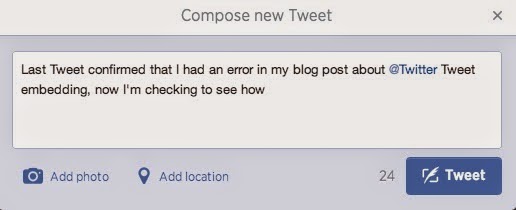
However, I can add it to a Tweet that only appears to have 24 characters remaining (i.e., the rest of the Tweet is actually 116-characters long).

New Tweet Prior to Adding the URL

Note that I'm able to comfortably insert the 57-character URL into the Tweet, and the "Tweet" button is still functioning, with an available character count of 0.

Tweet with Full URL

Also note that the Tweet URL took up 23 characters because I had to include a space between the last word "how" and the URL. Otherwise, Twitter doesn't acknowledge the URL as being an embedded Tweet and simply prevents me from sending out the Tweet.

Tweet without Space Showing It Is Too Long
In this case, you can see that the URL isn't recognized as such by Twitter. Consequently, the character count shows up as -33, and the "Tweet" button is grayed out showing that it is inactive.

All of the above screen shots were taken from Twitter.com on a Macbook Air using Chrome.

I also checked how this functionality worked on HootSuite, which I have previously mentioned is my preferred means of accessing Twitter on my laptop. And the same shortening behavior happened.

Tweet on Hootsuite Prior to Sending

Of course, the 23 characters required by Twitter's URL shortening of its own URL is still greater than the 11 characters that I was able to get using Ow.ly, but rather than being a saving of 46 characters, as I claimed in the original post, it is a mere 12 characters that are saved.

Even so, 12 characters does constitute nearly 10% of a Tweet's 140 total characters. Such a savings is not to be ignored lightly.

Thanks to the correspondent who told me about the error, and let me know via email and/or comments if you have any other ideas for saving characters or learning more about how Twitter's embedding functionality works.

Embedding Tweets?

Update: This post contains an error about the character counts of the URLs. That error was corrected via a more recent post, which can be accessed here: http://regulatoryrx.blogspot.com/2014/08/tweet-embedding-correction.html

Last week, Media Bistro had a story about Twitter enabling the embedding of Tweets, and several people asked me whether this would be useful for pharma to make use of social media and provide more information.

Here is a sample progression that I sent out much to my followers' annoyance (sorry about that!).

Original Tweet:
Original Tweet on Twitter.com

Here's the Tweet with the embedded portion as it appears on Twitter.com accessed from my Macbook Air using Chrome:

Embedded Tweet on Twitter.com


You won't always see exactly that same thing.

For example, here's what the Tweet looked like in my Hootsuite tab (again from Chrome on Macbook Air):

Embedded Tweet on Hootsuite

Note the important differences that the embedded Tweet appears fully as a picture-like object with the new Tweet on Twitter.com, but when using Hootsuite, you only see the URL for the original Tweet, and even that URL is cut off, so any information contained in the original Tweet only comes through on some platforms.

The mobile experience is also varied.

I use the official Twitter app on my iPhone.

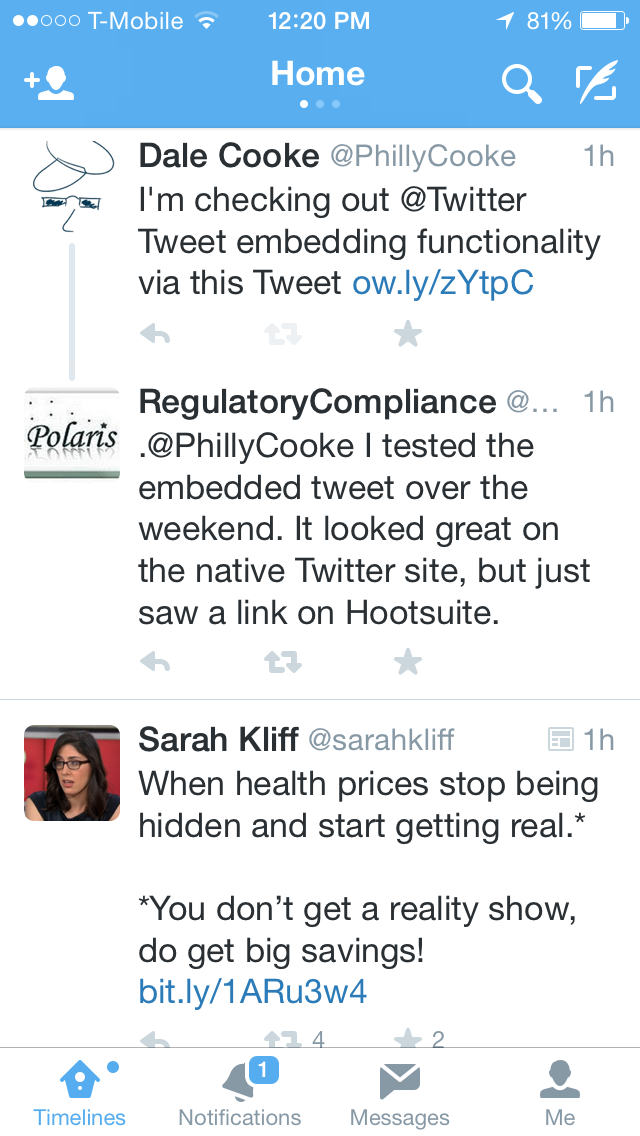
Here are the different views there. The first is what I see in my Twitter feed from the Home screen, showing my full Twitter stream:

Mobile View in Stream

Again, the full original Tweet is displayed with full attribution (Twitter handle, user name, and Twitter avatar).

Tapping the new Tweet (with the embedded Tweet inside it) takes you to a full screen display of the message.

Mobile View 2: Full Screen Display of Tweet

By contrast, tapping on the embedded Tweet opens only that Tweet in full screen.

Original Tweet on Mobile from Tapping on Embedded Portion

From the perspective of achieving compliance for using Twitter for marketing prescription products, I don't see how this will help much. While it is true that some people would be able to receive more information via a Tweet that contains an embedded Tweet (e.g., you could embed a Tweet dedicated solely to providing risk information), the variety in appearance is concerning. I wouldn't feel comfortable relying on the fact that people would access my Tweet via Twitter.com or via the official Twitter app, instead of using a third-party platform, such as Hootsuite.

Indeed, when I'm on my laptop, I almost exclusively use Hootsuite to access Twitter, rather than using Twitter.com; so unless there were a means to restrict access to the message to people using platforms that accommodate Tweet embedding, I'd be averse to relying on this mechanism to provide mandatory information in a Tweet (such as risk information).

I also am not sure whether the FDA would regard information presented via an embedded Tweet as having comparable prominence to information presented in the primary Tweet. That's important for the presentation of risk information to meet the fair balance requirement.

There is another problem with this method of providing information.

To get the embedding to function as demonstrated above, you must include the full URL of the original Tweet in the new Tweet. Here's what that looks like:

Tweet with Full URL Displayed

As you can see, the full URL is extremely long. In my example it takes up 57 characters of the 140 allowed, and if you use a URL shortener, then the functionality fails. Here's the view on Hootsuite:

Embedded Tweet Using URL Shortener on Hootsuite

Of course, embedded Tweets don't show on Hootsuite, so I also checked on Twitter.com. Here's that view:
URL Shortener Usage on Twitter.com
And I checked the mobile view in the official Twitter app.
URL Shortener Usage on Mobile in Stream

In both cases, only the shortened URL was displayed. That's a real shame as the savings of 46 characters (11 for shortened URL vs. 57 for the full URL) is huge in the realm of Tweets.

When I looked on mobile, I noticed another interesting feature. Namely, that while viewing your own Tweets from the Me portion of the app, the embedded Tweet doesn't appear, even when you provide the full URL. It actually looks the same as the Hootsuite view, presenting just the beginning of the full URL.

Multiple Embedded Tweets on Mobile Showing Shortener Usage
So, while embedding Tweets could certainly play a role in providing Twitter users with a way to include much more valuable information in this important platform, I'm afraid that at the moment it won't significantly expand the ability to use Twitter compliantly for manufacturers of prescription products.

h/t to Alec Gaffney & Polaris Consulting for this post.


460 to Follow

Alec Gaffney of RAPS has compiled an extremely valuable list of Twitter accounts for people in regulatory affairs to follow. The list includes governmental accounts, members of the press, industry accounts, and consultants such as yours truly.

I'm very pleased to be included in the list, and if you're looking to start using Twitter for regulatory intelligence, I strongly recommend that you start by combing this list for the accounts that most fit your interests.

Here's the link to the full list: http://www.raps.org/regulatory-focus/twitter/

Still feeling the need to chat?

The highly anticipated FDA social media webinar happened today. Apparently, some people were able to attend; though based on my Twitter feed, it seemed as if more people were having problems than actually getting in.

I was one of those who experienced difficulties. I logged in at 1:45 for the 2 p.m. start because FDA had warned that it was already booked to max capacity. I received a message that the webinar hadn't begun and would start at 2 p.m.

2 p.m. came and no webinar, then 2:05. Then, I started scrambling trying to log in in a different browser, reloading the page, even restarted my computer.

Then (of course), I started checking Twitter and saw that other people were experiencing the same problems.

I received an email from FDA with a new link that also didn't work.

@US_FDA Tweeted out a message acknowledging the problems and promising to post slides later. BTW, they're here.

From what I can tell based on the commentary on Twitter, there was very little new ground covered. The consensus of the Twitter discussion was that FDA largely read directly from the guidances themselves (the slides seem to back up that view) and only chose questions to answer that were already answered in the guidance themselves.

As for the guidances themselves, I would suggest that there are still many unanswered questions, including this and this.

For an overview of the guidances, I'd recommend this one.

And given all of the technical difficulties and limited Q&A, I'm renewing my call for a Twitter chat about the guidances. If CDRH can do it, I'm not sure why the rest of the agency can't.

FDA Social Media Guidance Webinar

I have been trying to get the FDA to host a Twitter chat, having suggested it on Twitter, and then followed up on this blog.

This morning @US_FDA announced that there will be a social media webinar later this week. There isn't much information about the webinar at the registration page, but the confirmation email includes the following description:
The purpose of this webinar is to provide an introduction and overview of FDA’s three recently issued social media draft guidances Fulfilling Regulatory Requirements for Postmarketing Submissions of Interactive Promotional Media for Prescription Human and Animal Drugs and Biologics,  Internet/Social Media Platforms with Character Space Limitations— Presenting Risk and Benefit Information for Prescription Drugs and Medical Devices and Internet/Social Media Platforms: Correcting Independent Third-Party Misinformation About Prescription Drugs and Medical Devices. Subject-matter experts will also be available to answer questions regarding the draft guidances and provide further explanation of key concepts.

I hope you'll join the webinar as I'm sure we're all anxious to have this Q&A on the three social media guidances this year.

A Different Twitter Proposal

I've been thinking further about the FDA social media guidances delivered this week and especially the "Twitter" guidance, which isn't just about Twitter, but which does have significant implications for brand communications on Twitter.

What if the FDA had proposed a different framework?

Here's the FDA's sample compliant Tweet:
NoFocus (rememberine HCl) for mild to moderate memory loss-May cause seizures in patients with a seizure disorder www.nofocus.com/risk 
This Tweet takes up 134 of the 140 characters available on Twitter. It includes
  • Brand name (NoFocus--7 characters)
  • Established name (rememberine HCl--17 characters including space and parentheses)
  • Link to risk that includes both brand name & indication that risks are presented (www.nofocus.com/risk--20 characters)
  • A hyphen to separate benefit from risk info (1 character)
These are the mandatory elements of the Tweet, and they take up 43 characters with the balance available for communicating both the most serious risks and a non-misleading indication statement.*

Of course, the exact length of the brand and established names will change the number of characters that are set aside for accommodating the FDA's proposed mandatory elements. 

One challenge is that almost no brands will be able to provide a non-misleading indication statement and all of the most serious risks** in the space that's available after meeting FDA's mandatory elements. 

Another challenge is that although the FDA might not object to the sample Tweet they provided, users of Twitters certainly would object. Their objection wouldn't be to the regulatory compliance of the Tweet. Their objection would be to its value, as in, it has none. While such a Tweet might occasionally be useful for some products, and perhaps be a promoted Tweet on occasion, not many people would be inclined to follow an account peppered with this type of content.

The sample Tweet provided by the FDA is analogous to someone going on Twitter and saying, "I'm great. Read more about me here." And although some people do in fact use Twitter to do that, people who primarily send out such communications are rarely successful. Instead, communications need to meet the needs of the other users of Twitter, who might be looking for information about a product, news, etc. 

Responding to such information seeking behavior and providing customer service are two of the best uses of Twitter by companies (not just pharmaceutical companies), and it is not unreasonable to believe that most of these needs can be fulfilled without providing any benefit information about the product. So, if, for example, I want to know how to sign up for a co-pay program for your brand, just getting a reminder-style Tweet with a link to the co-pay program link can be very useful. Some companies are already engaging in this type of activity.

That's one reason that it was so disappointing that the guidance didn't address reminder ad formats.

However, on occasion, there might be a need to include benefit information, and when that happens, the format set forth in this guidance is greatly limiting and not likely to be accessible to most brands. So, instead, I was considering a format along the following lines:

The brand name would be presented in the Twitter handle, not the body of the Tweet itself. The Twitter handle has a 15-character limitation, and limited risk information could be presented in the Tweet in a manner that makes clear that additional risk info is available at the destination URL.

Modifying the FDA's Tweet to meet this proposal would yield this sample Tweet:
For mild to moderate memory loss-Risks incl seizures in some ppl bit.ly/isi
Assuming this Tweet was sent from @NoFocus, let's see how that Tweet compares to FDA's format.

Because both the brand name and the generic are omitted from the Tweet itself, that eliminates 25 characters from the Tweet that were taken up by those two elements plus the space between them. I expanded from the hyphen to include the phrase "Risks incl" so that's a growth from one character to 11, but I did that both to provide explanation for users about what the next few characters were going to present as well as to set up the expectation that the link that is provided will have further risk information. It is extremely common on Twitter to abbreviate the word "include" with "incl" so that is likely to be understood by most users of the platform.

Then, I made use of a URL shortener (bit.ly) and a common abbreviation for the page name (isi) where the risk information is provided. This meets the FDA's criterion for the URL that it not be promotional in content or tone, and because I preceded it with the phrase "Risks incl" users expect to find product risks presented at that page, which the FDA accomplished in its example by including the product name and word "risk" in the URL itself.

The phrase "Risks incl" also accomplishes the goal of clearly communicating within the Tweet itself that the brand is NOT providing all of the risks associated with the product within the Tweet itself. So, users are alerted that there are other risks to the product and they can learn more by clicking on the link. 

The revised Tweet is only 75 characters with 21 characters devoted to providing mandatory risk information, not including the risk statement itself which would vary by brand:
  • The phrase "-Risks incl" (11 characters)
  • A shorter url linking to the risk information (bit.ly/isi--10 characters)
And in that case, I would be able to provide additional links or other information such as directing this Tweet to another user. Imagine the following exchange:***
@phillycooke: My father was prescribed Brandufate by his doctor. What does Brandufate do?
@Brandufate: @phillycooke It's for mild to moderate memory loss-Risks incl seizures in some ppl bit.ly/isi
In the conversation, I have now presumably provided some value to the person who was looking for information about my product, while meeting almost all of the FDA's requirement.

I write "almost all" because I didn't include the generic/established name in this example. My belief is that in this type of space-limited context, it would be better for the FDA to permit that the established name be provided via the landing page with the risk information, not in the Tweet itself. I believe that meets the needs of users better and also provides extremely valuable characters for communication in the Tweets themselves.

The FDA's guidance explicitly points out that it is not addressing the landing pages, home pages for brands on Twitter, etc.. It is worth noting, though, that a brand's participation on Twitter is not limited to the Tweets it sends, but also includes the brand's home page, description, and a Twitter icon. These other locations provide what I believe are more appropriate locations for presenting the full brand and generic names in compliance with all of the FDA requirements for presenting the established name.

And because Twitter has a verification service available, it would be possible for users to understand via the blue checkmark icon that the account providing them information is an official representation of the brand, who is subjected to FDA regulatory oversight and therefore meets a higher standard for accuracy.

I'd love to get some additional feedback on this proposal, so post your comments, send me your emails, and let me know.


* Keep in mind that the FDA is saying that both of these elements are required. It is not OK to omit either the risk or the indication statement.

** And the guidance is unambiguous about the need to include ALL of the most serious risks. Quoting from the guidance
At a minimum, a firm should communicate the most serious risks associated with the product together with the benefit information within the individual character-space-limited communication. For a prescription human drug, the most serious risks would generally include all risk concepts from a boxed warning, all risks that are known to be fatal or life-threatening, and all contraindications from the approved product labeling (the PI). (p. 9)

*** For my modified Tweet, I'm changing the brand name because @NoFocus actually exists on Twitter as a user. I created an account for @Brandufate for demonstration purposes. 

Let's have a chat!

Some of you might recall that in the fall, CDRH released a finalized version of its mobile apps guidance (see here and here on that). A few days later, they hosted a live Twitter chat on the topic. They used the hashtag #FDAapps and have actually kept that going for ongoing updates.

I participated, as did I'm sure many of you, and it extremely informative. I commend CDRH for setting the precedent and embracing new platforms for outreach.

In that same spirit, I suggest that now is the perfect time for OPDP, APLB, and CVM's advertising arm to join Twitter (none has an official Twitter presence so far as I'm aware and based on the FDA's official listing of social media accounts) and talk about the new social media guidance on presenting benefit and risk information in space-limited contexts. This seems especially appropriate given that the guidance dwells so heavily on Twitter usage.

I floated the suggestion on Twitter yesterday, and @FDAmedia picked up on it. So, now, I'm hoping you'll help me keep the conversation going by Tweeting, posting, sharing, etc., to see whether we can get FDA to participate.

And even if we can't get FDA's involvement, let's plan on holding a Twitter chat of our own on this topic soon.

Twitter Redesign

Twitter has announced a redesign that will be mandatory for all users as of May 28.

My colleague Sam Arabolu put together a primer on the changes and how it will affect pharma marketers in particular. You can access the primer here: http://ht.ly/wA4no

Twitter Profile Updates

Twitter announced today via a blog post that they are rolling out a new profile page format. For pharmaceutical marketers using Twitter, this means updating profile pages and if a product is mentioned, refiling the updated pages with the FDA under form 2253.

I mentioned this issue in a discussion of the Facebook adjustments to its brand pages just a few weeks ago.