Showing posts with label SEM. Show all posts

WTA?

Disclosure: I sit on the Google Health Advisory Board, and Google has been a client of PhillyCooke Consulting. Nothing in this post has been shown to Google or received the endorsement or approval of anyone at Google. I have discussed the topic of this post with Google employees.

"Why this ad?" (WTA) functionality has suddenly become hot news in the pharmaceutical industry. For those of you who have not noticed it previously, or heard the hubbub, here's the deal.

Google takes transparency quite seriously, and given the privacy concerns everyone has about trusting any company with as much information as Google maintains on people, it's understandable why.

As part of its transparency efforts, Google added some new functionality to its search engine marketing (SEM) results a few years ago. Users are able to learn why a particular ad is being presented to them.

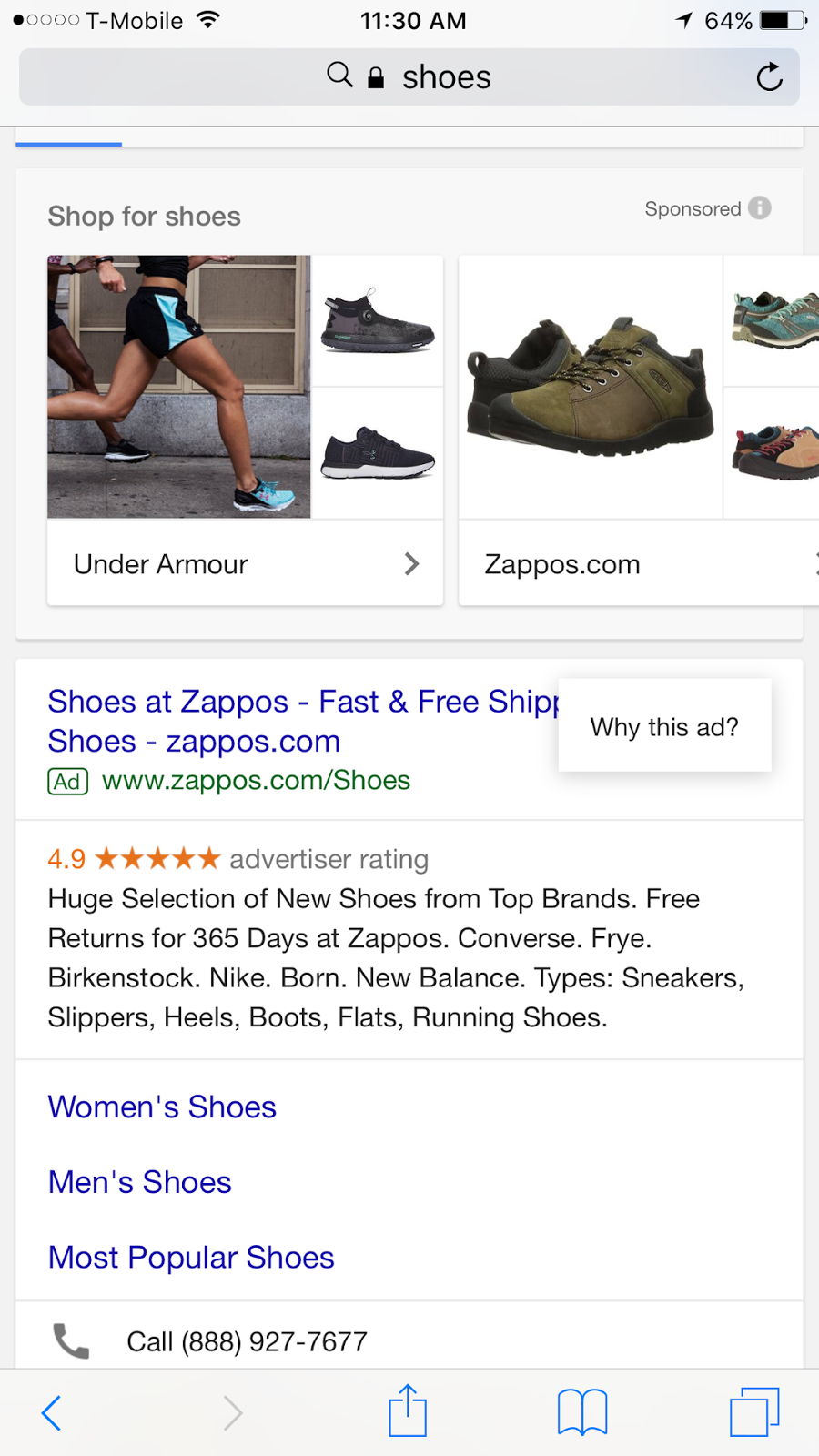
In practice what users see is a symbol (either an encircled letter "i" or a green triangle) next to a promoted message.


The red box surrounds the symbol in mobile and desktop search results that
enable the user to learn more about the ad targeting.
Users who click on the symbol see a question appear, "Why this ad?"


These images show the "Why this ad?" popup that users see after clicking on the symbol.

Clicking on the question prompts a further box to appear with information about why that particular ad was displayed to the user.


There are differences between the functionality in a desktop/laptop and a mobile environment. For example, in the mobile environment, the shadow box effect obscures and separates the underlying ad from the information supplied by Google more than the overlaid box alone that is seen on a laptop.

Both mobile and desktop ads display the root URL of the destination from the ad at the top of the box, and both allow signed-in users to opt out of seeing ads from that URL via a slider at the bottom of the box, which again displays that root URL of the destination webpage.

The reasons provided for what the ad is based on will vary depending on what caused the ad to appear. The factors listed in SEM ads will always include the search terms and might also include factors such as location (if the user permits Google to access that information) or that the user has previously visited the site.

The WTA information and functionality is not advertising content. No advertiser is permitted to alter this content or has any control over it. Advertisers indirectly influence it via the parameters that they set for determining when their ads appear. For example, if an advertiser targets only users who have previously visited their website, then that factor might appear, whereas if the targeting is solely based on the search terms, then it would be less likely to appear.

Some people have recently learned about this functionality and raised questions about whether it poses a potential risk for violating the Food and Drug Administration's (FDA) advertising regulations.

The scenario these people envision is that a company is using a redirecting ad, which by definition doesn't include the brand name in the ad itself but instead redirects users to a Brand.com website. If a user sees such an ad and clicks on the WTA symbol, and then clicks a second time on the "Why this ad?" popup, the user will see the brand name appearing because the brand name is most often the root URL of the home page for the destination of the redirecting ad.

The FDA has made clear via previous enforcement actions (such as many of the infamous 14 search letters from 2009) that merely using the brand name in a URL is considered by the FDA to be a mention of the drug for the purposes of advertising the product, and carries with it all of the requirements associated with any other product name mention.

Depending on the type of ad, the requirements might include only the inclusion of the brand and generic names and the relative sizing of the two, or they could be as extensive as the inclusion of the complete indication statement, dosage form, etc., associated with a full product promotion.

Let's first address the idea that a company could be out of compliance because the brand name of its product appeared without the generic name. The brand name is appearing in a location over which the company has no control. As mentioned earlier, the popup box is not itself an advertising unit. Companies cannot ask Google to change the information that appears in the box, and they have no control over it. There is some indirect influence, but this is definitely not a company-owned or company-controlled communication. Consequently, it would seem that this appearance of the brand name would be analogous to a newspaper using the brand name, and newspapers frequently use the brand name of drugs without including the generic name. 

FDA would never take enforcement action against a company for that type of third-party action, and it is hard to imagine that they would do so here.

Then there's a second issue. Depending on whether a user is accessing the ad via a mobile device or a desktop computer, the user might be able to see the underlying ad at the same time as the overlay. It is certainly possible that this could mean that a user sees both the brand name and some of the underlying redirecting ad, which was so carefully designed by the company to avoid including the brand name. In some cases, there is information in the redirecting ad that would be considered by the FDA to describe the product's use. And in that same set of infamous letters from 2009, FDA made very clear that including some description of a product's use with the brand name carries with it the full requirements associated with a complete production promotion (indication statement, etc.).

Does that pose a risk of FDA enforcement? 

For FDA to take an enforcement action in this instance, FDA would have to hold a company accountable for a message over which it has complete control (the underlying redirecting ad) when that message is combined with a separate message over which the company has no control.

It seems hard to believe the FDA would do something like that.

I admit that I would be happier if the WTA overlay box behaved the same way on a desktop as it does on a mobile device, with the shadow box effect that obscures the underlying ad and that also makes the separation between the two communications more clear.

But even without this change being implemented, I see an extremely low risk that FDA would take an enforcement action for an advertising publisher creating a tool that reveals more information than an advertiser wanted included in their ad.

While Google is determining what (if any) changes to make to its WTA functionality in light of the latest stir, I would submit for all of the reasons above that this poses a low risk of enforcement.

Google's Latest Ad Format Update

Google recently announced a change to its standard ad unit. This marks the third significant change affecting marketers of prescription products in the past year who are using Google.

At this point, I'm definitely seeing the need to revisit my article on using Google to market prescription products and even the presentation from last fall's FDLI Advertising and Promotion conference is now out of date. Over the next few months, I will be providing more on that.

In the meantime, here's the skinny on the update.

Google is fully embracing a mobile-first world view and is expanding the character count limitations for text ads.

The chart below (lifted from Google's public blog post) shows the breakdown between the current and the new formats.


For the ad copy, an additional 35 characters will be available for the headline, and an additional 10 characters will be available for the description. As pointed out by Convergence Point Media, in practice, this might expand the total characters available in a description even more than 10 characters because the description will no longer be treated as two separate 35-characters fields. That might mean that marketers are able to avoid the waste that sometimes is entailed in the current two-line description.

The primary benefit for marketers of prescription products is that it will be easier to meet their requirements for promoting drugs without a black box via a reminder ad and for black box drugs to fit all of the required elements for a reminder-like ad. This is most particularly relevant to fixed dose combination products. When the product being promoted has four or five active ingredients, it can very quickly be difficult to fix everything into the current character count limitations. Yet, failure to use the full established name remains on FDA's radar both in guidance and enforcement as a key regulatory requirement.

In addition to this expansion of the character counts, the display URL will be treated differently. Currently, marketers are able to manually enter a distinct display URL for their ads. In the new ad format, the display URL will be "automatically extracted" from the destination URL, with some (but only minimal) ability to customize the display URL seen by users.

This change has far greater implications for prescription product marketers, as it is precisely the ability to have a difference between the destination and the display URL that enables marketers to make use of redirecting ads.

If the ads automatically extract the base URL from the destination URL, then the mismatch between display and destination URL that is essential to redirecting ads will no longer be possible. This would significantly limit prescription product marketers' options. 

The biggest concern is for smaller, less well known brands. For those brands a reminder ad is not viable because very few people are already aware of their brand name; hence a reminder ad that doesn't describe the product's use has no value. But if the redirecting ads are eliminated, then such lesser known brands would have no way of attracting people who are looking for treatments. By assumption, these brands are not as well known which also means that their organic listings are not likely to be very high, so this would have a deeply chilling effect on the information available to people using Google. In essence, Google paid search would no longer be a viable means for building brands, but only for maintaining brands built on other platforms.

At the moment, Google has not provided any information about when this update will move beyond its initial testing to be available for everyone, or when it will be mandatory that ads adopt this new format. For now, this is simply something that marketers and regulatory professionals will need to stay abreast of.

It is also important to note that Google isn't synonymous with search, though it is the largest platform by a significant margin. Yahoo! and Bing remain very large players in this arena, and there's no reason to assume that Yahoo! and Bing will automatically adopt Google's changes. As a practical matter, this will probably mean having multiple sets of paid search campaigns going through the review and approval process.

Google SEM Changes Update

In June, Google announced changes to the ways search engine marketing (SEM) would work for marketers of prescription drugs. The background on the changes and the full original update is available here.

Recently, Google has provided additional detail about the new vanity URL policy, some new options, and hard dates for implementation.

First a quick backgrounder (see the earlier post for a more extensive background).

Background

Google eliminated the black box ad format that was created in 2009, and it announced that changes would be coming to its policy on the use of redirecting URLs (aka vanity URLs) by marketers of prescription products. SEM ads that make use of redirecting URLs are one specific instance of a more general category of ad I call redirecting ads.

Redirecting ads are not limited to search engines, but they're featured very prominently in search engine marketing. The basic idea behind a redirecting ad is that the ad itself does not promote a prescription product, instead it directs viewers to another location (website, toll free number, etc.) where a prescription product is being promoted. Marketers of prescription products make use of them extensively in space-limited contexts, such as SEM, because it can be difficult to fit all of the required elements from a full product promotion into such contexts.

For SEM ads, marketers often have to use these ads because their only other option is using a reminder ad, and a reminder ad is by definition worthless if the person seeing the ad doesn't already know the name of the product.

So, the key features of a redirecting SEM ad are:

  1. Does not mention or imply a specific prescription product
  2. Provides a link to a prescription product website
  3. Displays a URL that does not match the destination page URL
It's that third element (the mismatch between the display and the destination URL) that has caused Google some agita. Google has long had a policy that prevents advertisers from having a significant mismatch between the display and destination URL. Google has previously been making an exception to that policy for marketers of prescription products precisely because there didn't seem to be any other option for them when a reminder ad would not work.

June Announcement

In June, Google announced that it would be changing its exception to that policy. At the time, Google said that instead of permitting marketers to invent their own display URL, Google would limit marketers to just three options.

  1. Use CompanyName as the display URL
  2. Use CompanyName.com as the display URL
  3. Use "Prescription treatment website" or "Prescription device website" as the display URL

Latest Update

Now, Google has changed those options. First, Option 1 is no longer available. The only possible display URL using a company's name is for the display URL to be CompanyName.com. Moreover, to use that option, the URL itself must be live and the advertiser must own the URL. It is important to note that although the DISPLAY URL will be CompanyName.com, the DESTINATION URL  (i.e., the page people land on when they click on the ad) is completely under the control of the advertiser and does not have to be the company's main website.


In addition, the display URLs available under Option 3 have expanded significantly. Whereas the June announcement mentioned only two possibilities ("Prescription treatment website" or "Prescription device website"), there are now six display URLs available in both English and Spanish. Those display URLs are:
  1. Prescription treatment website
  2. Prescription device website
  3. Medical device website
  4. Preventative treatment website
  5. Prescription contraception website
  6. Prescription vaccine website
In Spanish:
  1. Sitio de tratamientos con receta
  2. Sitio de dispositivos con receta
  3. Sitio de dispositivos médicos
  4. Sitio de tratamientos preventivos
  5. Sitio de anticonceptivos con receta
  6. Sitio de vacunas con receta

Again, just as was previously announced, manufacturers of prescription products will be able to choose any of these display URLs, but whereas "CompanyName" in CompanyName.com is a template that will be filled in with the actual company's name, the options above must appear exactly as presented.

Timing

In addition to this change in the number of options, and the Google text options, Google has also announced the timing for these changes to take effect. There are three timing deadlines to keep in mind. The first is now.

Marketers who choose to make use of the option to use CompanyName.com as the display URL can immediately begin doing so. There is no need to wait, but there's also no requirement to do that immediately.

The next milestone is February 1, 2016. Beginning on that date, all of the 12 display URLs (six in English and six in Spanish) will be available as possibilities for redirecting ads to use.

Finally, the deadline for transitioning to these new options is March 1, 2016. On that date, no ads that are running using customized vanity URLs will be able to run. All ads must switch over to either of the two options:
  1. CompanyName.com
  2. One of Google's 12 display URLs
    1. Prescription treatment website
    2. Prescription device website
    3. Medical device website
    4. Preventative treatment website
    5. Prescription contraception website
    6. Prescription vaccine website
    7. Sitio de tratamientos con receta
    8. Sitio de dispositivos con receta
    9. Sitio de dispositivos médicos
    10. Sitio de tratamientos preventivos
    11. Sitio de anticonceptivos con receta
    12. Sitio de vacunas con receta

Implications

Search engines are vital to people using the Internet looking for health information. Consequently, marketers cannot afford to ignore SEM ads, and since these changes have been announced, there is plenty of time to update SEM campaigns to conform to these new Google-specific guidelines, and it is worth emphasizing that as I write this blog post, there is no word as to whether Yahoo!, Bing, or other search engines will also be adopting similar policies.

Additionally, marketers and their regulatory counterparts will have to review these ads to determine whether they need to be adjusted beyond the change in URL to avoid the implication of a specific prescription product; and we will have to wait to see how users adapt to seeing multiple ads using the same words as their display URL for unique ads.