In two recent guidances, FDA has requested that sponsors submit materials "in an archivable format that allows FDA to view and interact with the submission in the same way as the end user (e.g., working links)."*
I understand the need to experience digital promotional communications in their native environment to fully appreciate the communication and ensure its compliance.** However, achieving the stated goal of creating an experience for the FDA reviewer in the submission that is the same as the end user is not practical.
The most common format for submitting materials to FDA for the postmarketing submission of promotional materials is via the .PDF document format. Websites, emails, and other digital tactics are converted into PDFs. Typically, this process is achieved by taking screen shots of each webpage or other unit, gathering those screens into a convertible format such as .jpeg files and combining those files into a single .PDF file.
There are various techniques for doing this, and lots of software out there to assist with both the screenshots and the conversions. Adobe has at various points provided software additions that purported to convert an entire website into a single .PDF file at the click of a button. I've worked with most if not all of these solutions, and none of them work. At the end of the day, the only reliable technique to create a .PDF file that looks like the finished piece is to do so manually.
To convert such a file into a piece that functions in the same way as the original thus requires manually building into the .PDF file individual links that move the user around the PDF in the same way as the hyperlinks behave in the website (or email, etc.).
Depending on the complexity of the original piece, that task can be considerable. For example, a 12-page website probably actually has about 25 pages once error states, index pages, and other miscellaneous aspects are included. Assuming 10 hyperlinks per page (which is low), that's more than 120 individual hyperlinks that have to be created (and checked) prior to submission. It's very easy to introduce an error during that manual build.
And the resulting PDF will never be used other than for a 2253 filing. So, there's a lot of effort to create something that no one (outside FDA and the sponsor company) will ever see. A lot of effort with a high likelihood of error for no benefit.
As if this were not reason enough to avoid creating this file, the timing for its creation could not be worse. Digital tactics aren't like print ads. When I submit a print ad to the FDA for a postmarketing submission, the actual ad itself is unlikely to be on newsstands for several days or even weeks. But a digital tactic will often go live immediately after the materials are submitted to the FDA. Every additional minute spent creating the file for the postmarketing submission is a delay in making the materials available.
This also ramps up the pressure on the ad agency or other responsible party to complete the submission as rapidly as possible. That pressure further increases the likelihood of an error being introduced.
To recap, creating fully functional PDFs that recreate the end user experience of a digital tactic is an expensive, time-consuming, error-laden process that delays the deployment of promotional communications and benefits no one other than the FDA reviewers. This is one time I think industry is likely to ignore FDA's request.
* Fulfilling Regulatory Requirements for Postmarketing Submissions of Interactive Promotional Media for Prescription Human and Animal Drugs and Biologics, page 6, note 7. See also "The website should allow the FDA reviewer to click on links within the website," in Providing Regulatory Submissions in Electronic and Non-Electronic Format—Promotional Labeling and Advertising Materials for Human Prescription Drugs, page 31.
** Indeed, a significant portion of my primer on this topic is devoted to the idea that reviewers have to understand and experience the platform to determine its compliance.
Showing posts with label #socmed. Show all posts
Showing posts with label #socmed. Show all posts

New Video Lecture Available
The Digital Health Coalition, where I serve as one of the Digital Scholars, has created a new online resource called the Digital Health Coalition Academy. At this online destination, they are providing a series of short videos about topics of interest to people working in the digital health space.
I am pleased that they asked me to create one of the inaugural presentations. I chose to update and slightly expand on the presentation I previously delivered at the FDLI enforcement conference.
I've previously asked on this blog how much value people get from the slide decks I post on SlideShare when there's no corresponding audio because I sometimes post unaltered decks that were not created as standalone pieces, but were intended to be accompanied by my narrative.
I've also previously declared my intention to start making more video content available, and though this presentation isn't on my YouTube channel, which remains woefully inadequate, I hope the DHC partnership will jump start that process.
Please provide any feedback in the comments or privately about whether you find the presentation useful, especially whether it was significantly more valuable than just the slides alone on SlideShare.
Upcoming Speaking Engagements
The conference season starts up in February, and I have a few engagements (listed in the right hand column as always) coming up. If you follow this blog, then keep in mind that I sometimes have discounts available and will send you the info if you register for updates or send me an email using the form that is also in the right hand column.
First up on Tuesday, February 10 is a webinar I'm delivering with LSTI on the current state of social media guidance. This is an updated version of the webinar that I presented in the fall on the same topic. Since that initial presentation, the comment period has closed on the two social media guidances from last summer (though of course, it's always permitted to send comments even after the docket is closed).
The following week on February 18-19, I'll be leading an exciting panel on leveraging innovative technologies at DIA's Marketing Pharmaceuticals conference. Here's the official description of the conference:
The week of February 23 will see me back in DC for the final session of the ACDRS program. This is something I started doing last year and really enjoy because of the intimate classroom setting of working with a group of professionals who have spent more than a year following the development of prescription drugs and studying the regulatory requirements. It's an intense program, and I speak in the final session dedicated to commercialization and (no surprise) the need to understand and leverage new and emerging communication channels.
Before that travel gets started, I'll be attending the local Philadelphia RAPS chapter meeting next week on Thursday, January 29. Gary Buehler from Teva Pharmaceuticals will be speaking about the Citizens Petition process and ways companies use it to delay introduction of generic versions of products. Gary spent nearly 10 years at FDA's office of generic drugs before moving over to Teva four years ago. It should be a great topic, and I hope you'll join.
But whether you're also in the Philadelphia area, will be traveling to one of these events, or joining a webinar remotely, please stop by or drop a line and say hello.
First up on Tuesday, February 10 is a webinar I'm delivering with LSTI on the current state of social media guidance. This is an updated version of the webinar that I presented in the fall on the same topic. Since that initial presentation, the comment period has closed on the two social media guidances from last summer (though of course, it's always permitted to send comments even after the docket is closed).
The following week on February 18-19, I'll be leading an exciting panel on leveraging innovative technologies at DIA's Marketing Pharmaceuticals conference. Here's the official description of the conference:
The panel I'm leading will feature participation by AstraZeneca, J&J, Twitter, and YouTube. Here's the description from the conference webpage:The importance of understanding the complex regulations regarding the marketing of pharmaceuticals, veterinary products, biologics, and medical devices has never been higher. The DIA Marketing Pharmaceuticals 2015 conference will explore drug and device marketing in an evolving environment while serving as a vital forum for all stakeholders involved with the marketing, advertising, and promotion of a wide range of health care products.Featured Topics:
- Latest enforcement actions and policies issued by the FDA
- Leveraging innovative technologies compliantly
- How other companies are complying with government regulatory requirements
- Best review and approval practices with industry colleagues
- Novel promotional tactics trending in the pharmaceutical industry
- Emerging issues in the oversight of marketing materials
Consumers and health care professionals rely on the Internet and their mobile devices as essential tools for finding information about health care, medicine, and other treatment options. Makers of prescription products have been lagging behind in the uptake of these tools. This session provides the hands-on experience of some of the people who are leveraging YouTube and Twitter at the time and in the platform that people are using.You can see the full conference agenda and get registration information here.
The week of February 23 will see me back in DC for the final session of the ACDRS program. This is something I started doing last year and really enjoy because of the intimate classroom setting of working with a group of professionals who have spent more than a year following the development of prescription drugs and studying the regulatory requirements. It's an intense program, and I speak in the final session dedicated to commercialization and (no surprise) the need to understand and leverage new and emerging communication channels.
Before that travel gets started, I'll be attending the local Philadelphia RAPS chapter meeting next week on Thursday, January 29. Gary Buehler from Teva Pharmaceuticals will be speaking about the Citizens Petition process and ways companies use it to delay introduction of generic versions of products. Gary spent nearly 10 years at FDA's office of generic drugs before moving over to Teva four years ago. It should be a great topic, and I hope you'll join.
But whether you're also in the Philadelphia area, will be traveling to one of these events, or joining a webinar remotely, please stop by or drop a line and say hello.
Redirecting Ads
Updated slightly to correct grammar and spelling, and to improve clarity.
In my article and presentation about search engine marketing for pharmaceutical products, I talk about a category of communications called Redirecting Ads.
These ads have the following characteristics:
In my article and presentation about search engine marketing for pharmaceutical products, I talk about a category of communications called Redirecting Ads.
These ads have the following characteristics:
- The ads link to a product site
- Do not mention a specific product
- Do not imply a specific product
There were many such ads present in the violative materials posted by the FDA in its 2009 enforcement action about paid search, but none of the ads were cited by the FDA as violative. Given that the FDA went out of its way to take such a massive enforcement action and made clear in subsequent statements that this was intended as a clear statement to industry about what was considered unacceptable in this vital medium, it seems clear to me that FDA's silence on Redirecting Ads was deliberate.
The meaning of the silence is debatable. Did FDA think that such ads were outside its purview (this is my view, BTW)? Did FDA think that such ads were unimportant? Did FDA believe these were not prominent enough to merit inclusion in the enforcement action? Did FDA not want to muddy the waters by including Redirecting Ads? Or was it some combination of these different factors? We don't know, and FDA hasn't said anything.
The reason such ads are important (indeed, I would say vital) to people making use of social media is that it can be difficult to include all of the information that FDA requires in a product promotion in certain space-constrained social media platforms. Redirecting Ads avoid the need for meeting all of those requirements by essentially asking people to go to a separate destination where the sponsor CAN meet those requirements.
There are, however, more questions about how to use such an ad format correctly and compliantly. We know from FDA enforcement actions in the past that simply omitting the brand and generic name from an ad does not mean that the ad is considered not to be a product promotion.* That's why I include the characteristic that Redirecting Ads also do not imply a specific product. How though do you avoid such implications?
One clear means of implying a specific product would be via description. You could, for example, state that the ad was for Pfizer's treatment for erectile dysfunction and without ever mentioning the product name, everyone would know which particular brand you were talking about. In the context of HCP-targeted communication, describing the mechanism of action for a product might be another way to clearly identify the product if only one such product exists.
Additionally, some tag lines or other brand assets have developed a prominence and a life of their own to such an extent that simply using the phrases that have become identified with the product constitutes a mention of the brand name or an implication about which product is being discussed. In this context, it is interesting to note some recent television advertising has been running without having received any FDA enforcement action. This advertising clearly leverages brand assets that are identified with a specific product, but nowhere in the ad is the product name mentioned.
I'm glad there is an ad currently running on TV doing this because regardless of this specific execution, it highlights that Redirecting Ads might be vital to social media, but they are in no way limited to social media. Indeed, this advertising format is frequently used in other product categories, such as teaser campaigns for movies, which do not reveal the exact nature of the product in the teaser communications themselves, but instead send people to another location (whether to visit a website or to call a phone number) to learn more.
One of the downsides to Redirecting Ads is that it unfortunately is also a technique used heavily in some of the less savory areas of online advertising and promotion. Indeed, that's one reason that some publications produce lists each year of the "most dangerous celebrities to search" because people pushing malware and viruses attempt to lure visitors by promising one experience in their search campaigns and then directing to other locations.
Recently, I have faced the question of whether Redirecting Ads are inherently limited because their success brings about the end of their utility.
For example, assume a sponsor of Brand X becomes enormously successful running a Redirecting Ad that reads, "Check out www.conditionXtreatment.com to alleviate your worst pain."
The more people click on the link and see the ad (which by definition explicitly discusses a specific product by name and meets all of the requirements for being a product promotion), the more they begin to associate both the website "www.conditionXtreatment.com" and the phrase "alleviate your worst pain" with Brand X. So, does there come a point where using either of those pieces of content becomes synonymous with using the name Brand X itself, and thus the ad that is intended to avoid mention of the product begins to be viewed as implying a specific product and thus violating the third condition for a Redirecting Ad?
It might. Indeed, there are brands whose taglines and marketing messages are probably better known than the brand name itself, but I suspect this problem would only arise after a Redirecting Ad campaign has been in the market for quite a while and thus marketers could feel confident in investing in such campaigns, though they will have to keep an eye out for when the proverbial Rubicon has been crossed.
* Yes, I do realize how convoluted this sentence construction is, but I also think it's necessary to make the point this way.
* Yes, I do realize how convoluted this sentence construction is, but I also think it's necessary to make the point this way.
Targeting a Competitor's Brand Name with Keywords
Although my article and presentation about search engine marketing included a lot of detail, there were some things that I didn't include.
One question that I frequently hear is about the propriety of targeting a competitive product name. In discussing this topic, I need to provide a disclaimer that I am not an attorney, and no advice from me should ever be construed as legal advice.
As for FDA compliance, I think it is perfectly OK to target a competitive brand with SEM ads depending on the type of ads and the way the targeting is conducted.
So, first a bit of background on keywords. From my recent article:
That doesn't mean anything goes, but it does mean that we don't have to recreate the wheel to determine whether it's appropriate to use certain keywords. We simply apply the same principles from the offline world to the online practice.
So, with regard to disease awareness ads (these are ads that lead to disease awareness websites that do not themselves make any representation about a specific product), it is certainly OK to use the name of any product that is approved to treat the condition in question to serve up such ads.
Of course, if the product is being used off-label to treat the condition, then the advertiser might want to be cautious about the use of that keyword, but note that I would not automatically say that it is inappropriate even then.
For example, if a sponsor is currently investigating a product for an indication where there is not any FDA-approved treatments, and in the absence of any approved treatment, use of Product X has become the only resort for treating Condition Y, then a disease awareness campaign seeking to increase public knowledge about Condition Y might include Product X among its keywords, though probably only in conjunction with other keywords or negative keywords to try to target those people who are searching for information about treatments for Condition Y, rather than the audience of people who are searching for information about the approved indication for Product X.
Regarding redirecting ads, black box ad formats, and reminder ads, it would certainly be appropriate to target a competitor's product if both products have an identical indication or an identical population for at least one indication.
To see why, consider the following thought experiment. Imagine a breakthrough drug that creates an entirely new category of treatment. There is a long history of such medicines. Now, imagine a medical journal dedicating a special issue to the 10th anniversary of the approval of the first medicine in that category.
Would there be anything wrong with placing an ad for one of the newer medicines in that category in such an issue? For me, that answer is clearly no. So long as the newer medicine that is being advertised in that issue has the same indication (or a significantly overlapping indication) as the medicine that is the subject of the issue, then it would be OK to place the ad. The ad itself would have to be compliant, regardless of where it was placed, and that would mean that if the ad mentioned the competitive product that was the subject of the issue, then the claims would be comparative and in need of appropriate substantiation, but there's nothing inherently comparative in the placement itself.
The most common objection to such targeting is that such targeting can only be done if there is a head-to-head trial comparing the two drugs. I believe, however, that this conflates the content of the ad with the ad's placement. An ad whose content is not otherwise comparative in nature does not become comparative by virtue of placing it against a competitor.
In the case of a reminder ad or a black box ad, the compliant usage of such an ad format guarantees that there's nothing comparative in its content.
But what about the content of redirecting ads? Well, that's another blog post, and I'll address it tomorrow.
What constraints would I apply to targeting reminder ads or black box ad formats at a competitive product?
I find Venn diagrams the easiest way to explain the different scenarios:
In Scenario 1, Product A & B have identical indications. As I mentioned above, I think it's perfectly acceptable for either product to include its competitor among its keywords and deliver a branded advertising message via a reminder ad or black box ad to the users.
In Scenario 2, everyone who is indicated for Product B is also within the indicated population for Product A. This can happen, for example, when Product A has an indication covering adolescent, adult, and geriatric populations for a condition, but Product B only has an adult indication. My view is that Product A can use Product B as a keyword to deliver branded messaging because by hypothesis everyone indicated for Product B is also indicated for Product A. I do not, however, think the reverse is true. Product B should take precautions such as using "geriatric" and/or "elderly" as negative keywords if Product B wants to include Product A as a keyword.
In Scenario 3, both Product A & Product B might be able to use their competitor as a keyword, but the questions I would want to consider would be things such as how much overlap is there between the two indications, is it possible to distinguish people searching for Product A who ARE indicated for Product B from people searching for Product A who are NOT indicated for Product B. In some cases, such as when products have multiple indications, these questions might be very easily answered. In other cases, it might not be nearly as easy to target the appropriate population.
In all of these cases, my concern is not with the content of the ads themselves. Instead, my concern is that intentionally targeting a population that is not indicated for using my product on label could be evidence of an intent to market the product off-label. So, before engaging in such competitor targeting, I would want to be certain that I could justify my targeting practices as indeed being limited to the currently approved population.
One question that I frequently hear is about the propriety of targeting a competitive product name. In discussing this topic, I need to provide a disclaimer that I am not an attorney, and no advice from me should ever be construed as legal advice.
As for FDA compliance, I think it is perfectly OK to target a competitive brand with SEM ads depending on the type of ads and the way the targeting is conducted.
So, first a bit of background on keywords. From my recent article:
Keywords: Words entered into a search engine by a user. An advertiser identifies keywords that will trigger the appearance of their ad and places a bid for their preferred keywords.
So, keywords and their negative keyword counterparts function analogously to a media plan in traditional media, but instead of buying publications that are read by 18-25 year-old women, an advertiser places an ad in front of people who are entering certain words into their search engine. As such, the same rules that apply to appropriate offline ad placement apply to what makes for an appropriate keyword.Negative Keywords: Words selected by an advertiser that will prevent their ad from appearing.
That doesn't mean anything goes, but it does mean that we don't have to recreate the wheel to determine whether it's appropriate to use certain keywords. We simply apply the same principles from the offline world to the online practice.
So, with regard to disease awareness ads (these are ads that lead to disease awareness websites that do not themselves make any representation about a specific product), it is certainly OK to use the name of any product that is approved to treat the condition in question to serve up such ads.
Of course, if the product is being used off-label to treat the condition, then the advertiser might want to be cautious about the use of that keyword, but note that I would not automatically say that it is inappropriate even then.
For example, if a sponsor is currently investigating a product for an indication where there is not any FDA-approved treatments, and in the absence of any approved treatment, use of Product X has become the only resort for treating Condition Y, then a disease awareness campaign seeking to increase public knowledge about Condition Y might include Product X among its keywords, though probably only in conjunction with other keywords or negative keywords to try to target those people who are searching for information about treatments for Condition Y, rather than the audience of people who are searching for information about the approved indication for Product X.
Regarding redirecting ads, black box ad formats, and reminder ads, it would certainly be appropriate to target a competitor's product if both products have an identical indication or an identical population for at least one indication.
To see why, consider the following thought experiment. Imagine a breakthrough drug that creates an entirely new category of treatment. There is a long history of such medicines. Now, imagine a medical journal dedicating a special issue to the 10th anniversary of the approval of the first medicine in that category.
Would there be anything wrong with placing an ad for one of the newer medicines in that category in such an issue? For me, that answer is clearly no. So long as the newer medicine that is being advertised in that issue has the same indication (or a significantly overlapping indication) as the medicine that is the subject of the issue, then it would be OK to place the ad. The ad itself would have to be compliant, regardless of where it was placed, and that would mean that if the ad mentioned the competitive product that was the subject of the issue, then the claims would be comparative and in need of appropriate substantiation, but there's nothing inherently comparative in the placement itself.
The most common objection to such targeting is that such targeting can only be done if there is a head-to-head trial comparing the two drugs. I believe, however, that this conflates the content of the ad with the ad's placement. An ad whose content is not otherwise comparative in nature does not become comparative by virtue of placing it against a competitor.
In the case of a reminder ad or a black box ad, the compliant usage of such an ad format guarantees that there's nothing comparative in its content.
But what about the content of redirecting ads? Well, that's another blog post, and I'll address it tomorrow.
What constraints would I apply to targeting reminder ads or black box ad formats at a competitive product?
I find Venn diagrams the easiest way to explain the different scenarios:
 |
| Scenario 1: Product A & B have identical indications |
 |
| Scenario 2: Product B population is subset of Product A |
 |
| Scenario 3: Product A & B have overlapping, non-identical indications |
In all of these cases, my concern is not with the content of the ads themselves. Instead, my concern is that intentionally targeting a population that is not indicated for using my product on label could be evidence of an intent to market the product off-label. So, before engaging in such competitor targeting, I would want to be certain that I could justify my targeting practices as indeed being limited to the currently approved population.
Developing Compliant Search Engine Marketing
The week of Google text ads is here, at least for me and readers of this blog.
Last week, I spoke at a CBI social media summit about this topic, and on Monday, my article about the same topic was published by RAPS in its September issue of Regulatory Focus. By the way, this issue was guest edited by John Driscoll, and RAPS members can read more exclusive content at the RAPS website.
As always, I'm posting the article to my Scribd.com page and the presentation to my SlideShare page (links always available in the right rail).
But wait there's more!
All week, I'll be posting on some of the topics that didn't make the final cut for either the article or the presentation because it is definitely worth examining what I regard as the most important promotional tactic in the contemporary marketer's mix.
But wait there's more!
All week, I'll be posting on some of the topics that didn't make the final cut for either the article or the presentation because it is definitely worth examining what I regard as the most important promotional tactic in the contemporary marketer's mix.
By the way, my distribution list received an email about this yesterday. To make sure you don't miss any new developments, just complete the contact form (also in the right rail).
I also offer discounts to speaking engagements and training sessions exclusively to people on my distribution list, and I promise not to spam you. So, hey, sign up for the list.
Finally, keep in mind that I'm available for a training session to help your company understand how to make use of this incredibly important technique and to design policies and procedures to ensure all of your promotional communications are compliant. Just fill out the contact form in the right rail and request a free initial consultation.
Avoiding Cherry Picking
I spoke at CBI's Social Media summit on Friday. It was a good session with lively discussion.
Among the questions that came up was addressing the FDA guidance on correcting misinformation. Attendees were interested in how to avoid the accusation of cherry picking what is correcting.
I emphasized in my response the need to have policies, procedures and documentation to handle this effectively. Specifically, your procedures for correcting misinformation should require (among other things) that the people who are responsible for correcting misinformation must clearly indicate prior to the review being conducted, exactly what they will be reviewing. They might specify a blog post, or a series of comments, or all blog posts between certain dates, etc.
Then, the people should identify ALL misinformation identified within that pre-specified area.
Separately, there needs to be a standard evaluated for determining what level and types of misinformation will be corrected. For example, only correcting misinformation about currently approved indications or correcting all misinformation regarding the product safety and risks but nothing regarding its efficacy.
Finally, the procedure for correcting the misinformation has to be spelled out.
Falling all of these procedures, and applying those procedures and standards to everything that is found without regard for whether the information being corrected is positive or negative about the product should protect companies from the accusation of cherry picking.
Among the questions that came up was addressing the FDA guidance on correcting misinformation. Attendees were interested in how to avoid the accusation of cherry picking what is correcting.
I emphasized in my response the need to have policies, procedures and documentation to handle this effectively. Specifically, your procedures for correcting misinformation should require (among other things) that the people who are responsible for correcting misinformation must clearly indicate prior to the review being conducted, exactly what they will be reviewing. They might specify a blog post, or a series of comments, or all blog posts between certain dates, etc.
Then, the people should identify ALL misinformation identified within that pre-specified area.
Separately, there needs to be a standard evaluated for determining what level and types of misinformation will be corrected. For example, only correcting misinformation about currently approved indications or correcting all misinformation regarding the product safety and risks but nothing regarding its efficacy.
Finally, the procedure for correcting the misinformation has to be spelled out.
Falling all of these procedures, and applying those procedures and standards to everything that is found without regard for whether the information being corrected is positive or negative about the product should protect companies from the accusation of cherry picking.
Why URL Shorteners Matter
Tom commented on a previous post about inVentiv Health's new URL shortener that all of this discussion is moot because we're all being forced to adopt Twitter's shortener anyway, and Marco followed up with some additional clarifications.
Both cite Twitter's support pages about this topic here and here.
So, there's an important correction to the previous post, and there's also a question about why I obsess on character counts and shorteners in general.
First, the correction.
I thought Twitter's 22-character limit on a URL was a maximum, not a minimum. It turns out it's both. No matter how short (or long) a URL is, when it is included in a Tweet, Twitter allocates 22 characters for the link and uses its t.co shortener service to send the user on his/her way to the destination URL.
Importantly, that limitation is different from what displays. A message that is too long will not necessarily display in its entirety, but the URL will count toward only 22 characters of your 140 character total.
Consequently, no URL shortener can offer character savings, and my claim that inVentiv Health was offering a real (though small) savings in the character count was wrong.
However, URL shorteners still matter.
To understand why, you have to first recognize that URL shorteners are just a special case of using URL redirects. URL redirects are simply ways having a user end up a different URL destination than what they click on (or enter into their browser's address bar).
There are many reasons why people make use of redirects. First, websites are constantly evolving and changing. When such changes happen, there's a need to send people using old URLs someplace, and redirects are an option instead of setting up error pages or making people find their way manually to their destination.
Second, some destination URLs are unwieldy. People can find long URLs difficult to read, comprehend, and type. By contrast, a redirect can be much shorter and easier to use.
Third, (and this one matters most to pharmaceutical marketers) there need not be any connection between the information or words provided in the redirecting URL and the eventual destination URL. That matters to pharmaceutical marketers because going back many years, FDA has made clear that usage of a product name in a URL counts as a mention of the product name. And that matters to pharmaceutical marketers because use of a brand name automatically brings with it certain requirements, such as the inclusion of the generic name, whereas a URL redirect enables you to avoid that product mention.
URL shorteners are just one special case of these redirects that provide the benefits of being easier to type. Because URL shorteners work by having an extremely brief root URL while appending a random string of characters to the end, they are not typically easier to read or comprehend.
There has been only one enforcement action from FDA's OPDP for the use of a URL redirect that I am aware of.
FDA made clear that the issue with the ad subject to the enforcement was that the other parts of the ad so clearly identified the product that the mere omission of the product name was not itself sufficient to claim that the ad was not a product promotion. So, one issue when using a redirect (whether shortening or not) is that you cannot simply assume that because the brand name has been removed from the URL that you have thereby prevented your ad from being a product promotion.
If, for example, your company makes only one product in a specific therapeutic category and is well known for doing so, then putting together a message that mentions your company name and the category is likely to be problematic.
Bringing all of this back to inVentiv Health's new shortener, using such a service will not save you characters on Twitter (though of course each platform is unique, and it might offer such a savings on other platforms).
It does, however, provide the advantage of avoiding the mention of a product in the URL that a user sees while still clearly communicating to the user that he or she is going to a webpage for a prescription product that communicates risk information. And these benefits will, to my mind, be more significant if the service becomes standard throughout the industry instead of each company developing their own shortener.
Both cite Twitter's support pages about this topic here and here.
So, there's an important correction to the previous post, and there's also a question about why I obsess on character counts and shorteners in general.
First, the correction.
I thought Twitter's 22-character limit on a URL was a maximum, not a minimum. It turns out it's both. No matter how short (or long) a URL is, when it is included in a Tweet, Twitter allocates 22 characters for the link and uses its t.co shortener service to send the user on his/her way to the destination URL.
Importantly, that limitation is different from what displays. A message that is too long will not necessarily display in its entirety, but the URL will count toward only 22 characters of your 140 character total.
Consequently, no URL shortener can offer character savings, and my claim that inVentiv Health was offering a real (though small) savings in the character count was wrong.
However, URL shorteners still matter.
To understand why, you have to first recognize that URL shorteners are just a special case of using URL redirects. URL redirects are simply ways having a user end up a different URL destination than what they click on (or enter into their browser's address bar).
There are many reasons why people make use of redirects. First, websites are constantly evolving and changing. When such changes happen, there's a need to send people using old URLs someplace, and redirects are an option instead of setting up error pages or making people find their way manually to their destination.
Second, some destination URLs are unwieldy. People can find long URLs difficult to read, comprehend, and type. By contrast, a redirect can be much shorter and easier to use.
Third, (and this one matters most to pharmaceutical marketers) there need not be any connection between the information or words provided in the redirecting URL and the eventual destination URL. That matters to pharmaceutical marketers because going back many years, FDA has made clear that usage of a product name in a URL counts as a mention of the product name. And that matters to pharmaceutical marketers because use of a brand name automatically brings with it certain requirements, such as the inclusion of the generic name, whereas a URL redirect enables you to avoid that product mention.
URL shorteners are just one special case of these redirects that provide the benefits of being easier to type. Because URL shorteners work by having an extremely brief root URL while appending a random string of characters to the end, they are not typically easier to read or comprehend.
There has been only one enforcement action from FDA's OPDP for the use of a URL redirect that I am aware of.
FDA made clear that the issue with the ad subject to the enforcement was that the other parts of the ad so clearly identified the product that the mere omission of the product name was not itself sufficient to claim that the ad was not a product promotion. So, one issue when using a redirect (whether shortening or not) is that you cannot simply assume that because the brand name has been removed from the URL that you have thereby prevented your ad from being a product promotion.
If, for example, your company makes only one product in a specific therapeutic category and is well known for doing so, then putting together a message that mentions your company name and the category is likely to be problematic.
Bringing all of this back to inVentiv Health's new shortener, using such a service will not save you characters on Twitter (though of course each platform is unique, and it might offer such a savings on other platforms).
It does, however, provide the advantage of avoiding the mention of a product in the URL that a user sees while still clearly communicating to the user that he or she is going to a webpage for a prescription product that communicates risk information. And these benefits will, to my mind, be more significant if the service becomes standard throughout the industry instead of each company developing their own shortener.
New Link Shortener for Risk Info
Update: Comments on this post pointed out an error. A new blog post explains that error and provides further information on the use of URL shorteners. http://regulatoryrx.blogspot.com/2014/09/why-url-shorteners-matter.html
inVentiv Health has a new link shortener that appears to make a very valuable contribution to the use of Twitter by pharmaceutical companies.
As I've talked about extensively (e.g., here, here, and here), there are difficulties with trying to follow the FDA social media guidance on the presentation of risk information in space-constrained contexts because of how much stuff FDA wants included in any single message.
Specifically, FDA says messages must include:
1. Brand name
2. Generic name
3. Non-misleading indication statement
4. Abbreviated risk statement
5. Link to complete risk information
In FDA's own example, just including all of the required elements takes up 134 of the 140 characters available for a single message.
inVentiv's solution is quite clever. It provides the benefits of a URL shortener while addressing the objection from FDA that such shorteners tend to obscure the information in the destination.
The shortener from inVentiv appends to a root of "RxRi.sk/" a short character string to a specific page dedicated to risk information. By including both the standard abbreviation of Rx for a prescription drug and taking advantage of the top-level domain for Slovakia (.sk), combined with the two characters Ri, the shortener clearly communicates that the destination location will include risk information about a prescription product without using nearly as many characters as the FDA's example.
In a few tests, the shortened string appears to have a consistent 13 characters vs. the 20 characters in FDA's product name. Of course, the FDA's example included the unnecessary characters "www." at the beginning of the URL, so even FDA's example is really only 16 characters in length.
Is a three-character saving really that big a deal?
Yes, I think it is, and I think there are a few reasons for that. First, every character matters when we're dealing with Twitter. Shaving a few characters here and a few there will add up and make for a far more flexible framework.
Second, inVentiv is making this shortener available to everyone free of charge. Consequently, this can become an industry standard if people are willing to adopt it, and having consistency in such communication platforms will make it far easier for people, especially consumers who don't spend all day thinking about how the FDA regulates prescription drugs, but who just know that Tweets from the medicine they're taking include scary information. For them, gaining familiarity that drugs have risks, and here is where they can find the risks associated with their particular medicine is valuable.
Third, the three-character improvement is for FDA's fictional product name of "NoFocus." FDA's actual recommendation is to always include both the product name and the word "risk" in the URL that directs users to the full risk information. "NoFocus" has seven characters. That seems to be the norm for top brands, as a quick scan of the top 10 selling drugs in the past year reveals three names with six characters, three with seven, and two with eight characters. There are, however, some drugs with much longer names, and if you're marketing a product with 10 or 11 characters in the name (of an extended release version with an "XR" added to the URL) the savings can add up.
Having a standard means of providing this information takes one item off the table when drug names are being created and evaluated.
Of course, some of these benefits are only realized if in fact people adopt inVentiv's shortener and make it a standard. We'll see whether that happens or whether some additional competing services emerge. At the very least, inVentiv has moved the conversation one step forward.
inVentiv Health has a new link shortener that appears to make a very valuable contribution to the use of Twitter by pharmaceutical companies.
As I've talked about extensively (e.g., here, here, and here), there are difficulties with trying to follow the FDA social media guidance on the presentation of risk information in space-constrained contexts because of how much stuff FDA wants included in any single message.
Specifically, FDA says messages must include:
1. Brand name
2. Generic name
3. Non-misleading indication statement
4. Abbreviated risk statement
5. Link to complete risk information
In FDA's own example, just including all of the required elements takes up 134 of the 140 characters available for a single message.
NoFocus (rememberine HCl) for mild to moderate memory loss-May cause seizures in patients with a seizure disorder www.nofocus.com/risk (page 14)And FDA explicitly discourages the use of URL shorteners out of concern that the shorteners will obscure the nature of the information being linked to.
That puts sponsors in a bind because using the FDA's example, there were only six characters for the actual message itself after meeting the regulatory requirements.The Agency does not intend to object to the use of such URL shortening services; however, when possible, the Agency recommends that the URL or web address itself denote to the user that the landing page consists of risk information (e.g., www.product.com/risk). (page 10)
inVentiv's solution is quite clever. It provides the benefits of a URL shortener while addressing the objection from FDA that such shorteners tend to obscure the information in the destination.
The shortener from inVentiv appends to a root of "RxRi.sk/" a short character string to a specific page dedicated to risk information. By including both the standard abbreviation of Rx for a prescription drug and taking advantage of the top-level domain for Slovakia (.sk), combined with the two characters Ri, the shortener clearly communicates that the destination location will include risk information about a prescription product without using nearly as many characters as the FDA's example.
In a few tests, the shortened string appears to have a consistent 13 characters vs. the 20 characters in FDA's product name. Of course, the FDA's example included the unnecessary characters "www." at the beginning of the URL, so even FDA's example is really only 16 characters in length.
Is a three-character saving really that big a deal?
Yes, I think it is, and I think there are a few reasons for that. First, every character matters when we're dealing with Twitter. Shaving a few characters here and a few there will add up and make for a far more flexible framework.
Second, inVentiv is making this shortener available to everyone free of charge. Consequently, this can become an industry standard if people are willing to adopt it, and having consistency in such communication platforms will make it far easier for people, especially consumers who don't spend all day thinking about how the FDA regulates prescription drugs, but who just know that Tweets from the medicine they're taking include scary information. For them, gaining familiarity that drugs have risks, and here is where they can find the risks associated with their particular medicine is valuable.
Third, the three-character improvement is for FDA's fictional product name of "NoFocus." FDA's actual recommendation is to always include both the product name and the word "risk" in the URL that directs users to the full risk information. "NoFocus" has seven characters. That seems to be the norm for top brands, as a quick scan of the top 10 selling drugs in the past year reveals three names with six characters, three with seven, and two with eight characters. There are, however, some drugs with much longer names, and if you're marketing a product with 10 or 11 characters in the name (of an extended release version with an "XR" added to the URL) the savings can add up.
Having a standard means of providing this information takes one item off the table when drug names are being created and evaluated.
Of course, some of these benefits are only realized if in fact people adopt inVentiv's shortener and make it a standard. We'll see whether that happens or whether some additional competing services emerge. At the very least, inVentiv has moved the conversation one step forward.
Google Text Ads Revisited
I just submitted a draft of my article about Google text ads for the September issue of RAPS Regulatory Focus. I was surprised at how much has changed since my initial piece on this topic about two years ago.
If RAPS agrees, I'll make a copy available on my Scribd.com page (which is always accessible via the link in the right rail of the blog).
I'll also be drawing upon much of that material for a presentation I'm delivering on September 12 at the CBI Social Media Summit in Philadelphia. I hope you'll join us.
If RAPS agrees, I'll make a copy available on my Scribd.com page (which is always accessible via the link in the right rail of the blog).
I'll also be drawing upon much of that material for a presentation I'm delivering on September 12 at the CBI Social Media Summit in Philadelphia. I hope you'll join us.
Eliminating the Disparity in 2253 Filing Requirements
One of the difficulties with the guidance on Fulfilling Regulatory Requirements for Postmarketing Submissions of Interactive Promotional Media for Prescription Human and Animal Drugs and Biologics (or the 2253 guidance as I call it*) on social media is that it establishes a distinction in filing requirements between forums that are publicly accessible and those that are not.
Sponsors of prescription products who wish to engage in social media are granted two pathways via this guidance for meeting their 2253 filing requirements, which is the obligation to submit all promotional materials at the time of first use or prior to initial dissemination.
For forums that are publicly accessible, sponsors can submit the initial communication on a third-party site, along with any home or profile page, and the URL where the real-time communications will occur. Then, every month, firms should submit the list of all URLs where it is engaging in real-time communications.
However, forums that are not publicly accessible have a different requirement. Instead of merely submitting a list of URLs each month, FDA requests that sponsors who choose to use such forums submit screenshots of the interactions that occur.
It has been pointed out by others (including yours truly) that this distinction is difficult to understand or draw in practice. For example, many platforms have a minimal requirement that to view any discussions in the platform, you must be a member of (and logged in to your account on) the platform. Would such a requirement be seen by the FDA as making the site not publicly accessible?
Moreover, for third-party sites, this requirement might change without notice. Were that to happen, a sponsor could go from being in compliance to being out of compliance without having themselves made any changes, and that seems odd. It certainly seems that what a sponsor is operating compliantly should not depend on the policies of a third-party site.
Another difficulty is that the disparity in filing requirement is huge and would put a barrier in front of participating in non-restricted forums. Preparing all of the screenshots on a monthly basis could be a significant undertaking depending on the volume of the communications in the forum. While that might seem desirable at first blush, there are good reasons to want to operate such closed forum. Such forums enable, for example, full verification of credentials prior to admission. That means that information can be more freely shared without concern that people who should not have access to the information might receive it. For example, if I were the sponsor of a pain medication, I might want to discuss methods that some patients are using to circumvent abuse prevention mechanisms, but obviously I would not want that information to be available in a publicly accessible forum.
The essence behind this requirement seems to be the desire of FDA to monitor the real-time communications and to rely on the possibility of FDA monitoring of communications to ensure that all communications are appropriate.**
One way of addressing these concerns and eliminating the disparity in filing requirements is to require that when sponsors make use of third-party platforms with restricted access that they set up credentials for FDA to access the forum.
It would be easy for FDA to create an email address and name (e.g., OPDP Social Media & OPDPSocMed@FDA.gov) that could be created as a user for any restricted access platforms. To further simplify things, FDA could establish and publish a list of its credentials on the most prominent forums (e.g., YouTube, Facebook, LinkedIn, Twitter) for monitoring purposes. In that way, sponsors could simply create a user account with FDA's credentials when they set up their restricted-access forums. The sponsor could then include as part of their initial 2253 filing requirement a password (if required) for FDA to access the forum.
From that point forward, sponsors would then be on equal footing with the requirement simply to file monthly reports indicating their continued involvement in the platform but not being required to submit screenshots of all of the interactions.
This method would enable FDA to monitor the conversations in real-time without creating a disparity in filing or a barrier to establishing and maintaining restricted-access forums. It also would ensure that changes made by third-parties could not cause a sponsor to find themselves out of compliance with FDA requirements.
* It is worth noting that the guidance also affects filing of FDA Form 2301 for veterinary medicines. Nothing in this post is affected by this nuance.
** Quoting from the guidance, "if a site has restricted access and, as such, FDA may not have access to the site" (page 7, emphasis added)
Sponsors of prescription products who wish to engage in social media are granted two pathways via this guidance for meeting their 2253 filing requirements, which is the obligation to submit all promotional materials at the time of first use or prior to initial dissemination.
For forums that are publicly accessible, sponsors can submit the initial communication on a third-party site, along with any home or profile page, and the URL where the real-time communications will occur. Then, every month, firms should submit the list of all URLs where it is engaging in real-time communications.
However, forums that are not publicly accessible have a different requirement. Instead of merely submitting a list of URLs each month, FDA requests that sponsors who choose to use such forums submit screenshots of the interactions that occur.
It has been pointed out by others (including yours truly) that this distinction is difficult to understand or draw in practice. For example, many platforms have a minimal requirement that to view any discussions in the platform, you must be a member of (and logged in to your account on) the platform. Would such a requirement be seen by the FDA as making the site not publicly accessible?
Moreover, for third-party sites, this requirement might change without notice. Were that to happen, a sponsor could go from being in compliance to being out of compliance without having themselves made any changes, and that seems odd. It certainly seems that what a sponsor is operating compliantly should not depend on the policies of a third-party site.
Another difficulty is that the disparity in filing requirement is huge and would put a barrier in front of participating in non-restricted forums. Preparing all of the screenshots on a monthly basis could be a significant undertaking depending on the volume of the communications in the forum. While that might seem desirable at first blush, there are good reasons to want to operate such closed forum. Such forums enable, for example, full verification of credentials prior to admission. That means that information can be more freely shared without concern that people who should not have access to the information might receive it. For example, if I were the sponsor of a pain medication, I might want to discuss methods that some patients are using to circumvent abuse prevention mechanisms, but obviously I would not want that information to be available in a publicly accessible forum.
The essence behind this requirement seems to be the desire of FDA to monitor the real-time communications and to rely on the possibility of FDA monitoring of communications to ensure that all communications are appropriate.**
One way of addressing these concerns and eliminating the disparity in filing requirements is to require that when sponsors make use of third-party platforms with restricted access that they set up credentials for FDA to access the forum.
It would be easy for FDA to create an email address and name (e.g., OPDP Social Media & OPDPSocMed@FDA.gov) that could be created as a user for any restricted access platforms. To further simplify things, FDA could establish and publish a list of its credentials on the most prominent forums (e.g., YouTube, Facebook, LinkedIn, Twitter) for monitoring purposes. In that way, sponsors could simply create a user account with FDA's credentials when they set up their restricted-access forums. The sponsor could then include as part of their initial 2253 filing requirement a password (if required) for FDA to access the forum.
From that point forward, sponsors would then be on equal footing with the requirement simply to file monthly reports indicating their continued involvement in the platform but not being required to submit screenshots of all of the interactions.
This method would enable FDA to monitor the conversations in real-time without creating a disparity in filing or a barrier to establishing and maintaining restricted-access forums. It also would ensure that changes made by third-parties could not cause a sponsor to find themselves out of compliance with FDA requirements.
* It is worth noting that the guidance also affects filing of FDA Form 2301 for veterinary medicines. Nothing in this post is affected by this nuance.
** Quoting from the guidance, "if a site has restricted access and, as such, FDA may not have access to the site" (page 7, emphasis added)
YouTube Channel Launched
I'm always looking to expand in my use of social media and to provide more resources for others interested in using social media for promoting prescription products, so I just launched PhillyCooke's YouTube Channel.
Here is the link, which will also be featured in the widget on the right with the other online locations where you can find resources from me.
Right now, there is only one video, a short clip from the movie The Social Network, that I really liked because as much as I love social media, I have sometimes found it a frustrating experience, as I've talked about before, trying to figure out how all of this stuff works.
Here is the link, which will also be featured in the widget on the right with the other online locations where you can find resources from me.
Right now, there is only one video, a short clip from the movie The Social Network, that I really liked because as much as I love social media, I have sometimes found it a frustrating experience, as I've talked about before, trying to figure out how all of this stuff works.
Tweet Embedding Correction
My previous post on Twitter's new Tweet embedding feature contained an error that was pointed out to me by a correspondent.
I claimed that one of the drawbacks to the way Twitter was implementing Tweet embedding is that for the feature to function, you must include the full URL of the Tweet you want to embed in the new Tweet. As I wrote:
In fact, Twitter automatically shortens the URL, so that it is not the full character count of the URL that counts against the 140-character limit for each Tweet.
However, the character count for the URL is still not as short as a typical URL shortener.
Here were the results of playing with the functionality:
Again, I used the same Tweet for the embedding:
That Tweet is available at: https://twitter.com/PhillyCooke/status/496670428187090944
The full URL is 57-characters long.
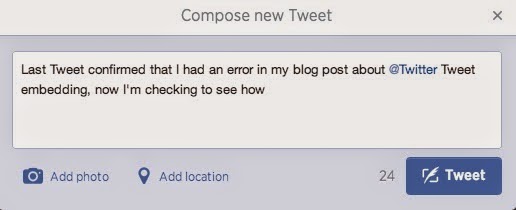
However, I can add it to a Tweet that only appears to have 24 characters remaining (i.e., the rest of the Tweet is actually 116-characters long).
Note that I'm able to comfortably insert the 57-character URL into the Tweet, and the "Tweet" button is still functioning, with an available character count of 0.
Of course, the 23 characters required by Twitter's URL shortening of its own URL is still greater than the 11 characters that I was able to get using Ow.ly, but rather than being a saving of 46 characters, as I claimed in the original post, it is a mere 12 characters that are saved.
Even so, 12 characters does constitute nearly 10% of a Tweet's 140 total characters. Such a savings is not to be ignored lightly.
Thanks to the correspondent who told me about the error, and let me know via email and/or comments if you have any other ideas for saving characters or learning more about how Twitter's embedding functionality works.
I claimed that one of the drawbacks to the way Twitter was implementing Tweet embedding is that for the feature to function, you must include the full URL of the Tweet you want to embed in the new Tweet. As I wrote:
To get the embedding to function as demonstrated above, you must include the full URL of the original Tweet in the new Tweet....the full URL is extremely long. In my example it takes up 57 characters of the 140 allowed...That was incorrect.
In fact, Twitter automatically shortens the URL, so that it is not the full character count of the URL that counts against the 140-character limit for each Tweet.
However, the character count for the URL is still not as short as a typical URL shortener.
Here were the results of playing with the functionality:
Again, I used the same Tweet for the embedding:
 |
| Original Tweet |
That Tweet is available at: https://twitter.com/PhillyCooke/status/496670428187090944
The full URL is 57-characters long.
However, I can add it to a Tweet that only appears to have 24 characters remaining (i.e., the rest of the Tweet is actually 116-characters long).
 |
| New Tweet Prior to Adding the URL |
Note that I'm able to comfortably insert the 57-character URL into the Tweet, and the "Tweet" button is still functioning, with an available character count of 0.
 |
| Tweet with Full URL |
Also note that the Tweet URL took up 23 characters because I had to include a space between the last word "how" and the URL. Otherwise, Twitter doesn't acknowledge the URL as being an embedded Tweet and simply prevents me from sending out the Tweet.
 |
| Tweet without Space Showing It Is Too Long |
In this case, you can see that the URL isn't recognized as such by Twitter. Consequently, the character count shows up as -33, and the "Tweet" button is grayed out showing that it is inactive.
All of the above screen shots were taken from Twitter.com on a Macbook Air using Chrome.
I also checked how this functionality worked on HootSuite, which I have previously mentioned is my preferred means of accessing Twitter on my laptop. And the same shortening behavior happened.
 |
| Tweet on Hootsuite Prior to Sending |
Of course, the 23 characters required by Twitter's URL shortening of its own URL is still greater than the 11 characters that I was able to get using Ow.ly, but rather than being a saving of 46 characters, as I claimed in the original post, it is a mere 12 characters that are saved.
Even so, 12 characters does constitute nearly 10% of a Tweet's 140 total characters. Such a savings is not to be ignored lightly.
Thanks to the correspondent who told me about the error, and let me know via email and/or comments if you have any other ideas for saving characters or learning more about how Twitter's embedding functionality works.
Embedding Tweets?
Update: This post contains an error about the character counts of the URLs. That error was corrected via a more recent post, which can be accessed here: http://regulatoryrx.blogspot.com/2014/08/tweet-embedding-correction.html
Last week, Media Bistro had a story about Twitter enabling the embedding of Tweets, and several people asked me whether this would be useful for pharma to make use of social media and provide more information.
Here is a sample progression that I sent out much to my followers' annoyance (sorry about that!).
Original Tweet:
You won't always see exactly that same thing.
For example, here's what the Tweet looked like in my Hootsuite tab (again from Chrome on Macbook Air):
Again, the full original Tweet is displayed with full attribution (Twitter handle, user name, and Twitter avatar).
Tapping the new Tweet (with the embedded Tweet inside it) takes you to a full screen display of the message.
By contrast, tapping on the embedded Tweet opens only that Tweet in full screen.
From the perspective of achieving compliance for using Twitter for marketing prescription products, I don't see how this will help much. While it is true that some people would be able to receive more information via a Tweet that contains an embedded Tweet (e.g., you could embed a Tweet dedicated solely to providing risk information), the variety in appearance is concerning. I wouldn't feel comfortable relying on the fact that people would access my Tweet via Twitter.com or via the official Twitter app, instead of using a third-party platform, such as Hootsuite.
Indeed, when I'm on my laptop, I almost exclusively use Hootsuite to access Twitter, rather than using Twitter.com; so unless there were a means to restrict access to the message to people using platforms that accommodate Tweet embedding, I'd be averse to relying on this mechanism to provide mandatory information in a Tweet (such as risk information).
I also am not sure whether the FDA would regard information presented via an embedded Tweet as having comparable prominence to information presented in the primary Tweet. That's important for the presentation of risk information to meet the fair balance requirement.
There is another problem with this method of providing information.
To get the embedding to function as demonstrated above, you must include the full URL of the original Tweet in the new Tweet. Here's what that looks like:
As you can see, the full URL is extremely long. In my example it takes up 57 characters of the 140 allowed, and if you use a URL shortener, then the functionality fails. Here's the view on Hootsuite:
Of course, embedded Tweets don't show on Hootsuite, so I also checked on Twitter.com. Here's that view:
And I checked the mobile view in the official Twitter app.
In both cases, only the shortened URL was displayed. That's a real shame as the savings of 46 characters (11 for shortened URL vs. 57 for the full URL) is huge in the realm of Tweets.
When I looked on mobile, I noticed another interesting feature. Namely, that while viewing your own Tweets from the Me portion of the app, the embedded Tweet doesn't appear, even when you provide the full URL. It actually looks the same as the Hootsuite view, presenting just the beginning of the full URL.
So, while embedding Tweets could certainly play a role in providing Twitter users with a way to include much more valuable information in this important platform, I'm afraid that at the moment it won't significantly expand the ability to use Twitter compliantly for manufacturers of prescription products.
h/t to Alec Gaffney & Polaris Consulting for this post.
Last week, Media Bistro had a story about Twitter enabling the embedding of Tweets, and several people asked me whether this would be useful for pharma to make use of social media and provide more information.
Here is a sample progression that I sent out much to my followers' annoyance (sorry about that!).
Original Tweet:
 |
| Original Tweet on Twitter.com |
Here's the Tweet with the embedded portion as it appears on Twitter.com accessed from my Macbook Air using Chrome:
 |
| Embedded Tweet on Twitter.com |
You won't always see exactly that same thing.
For example, here's what the Tweet looked like in my Hootsuite tab (again from Chrome on Macbook Air):
 |
| Embedded Tweet on Hootsuite |
Note the important differences that the embedded Tweet appears fully as a picture-like object with the new Tweet on Twitter.com, but when using Hootsuite, you only see the URL for the original Tweet, and even that URL is cut off, so any information contained in the original Tweet only comes through on some platforms.
The mobile experience is also varied.
I use the official Twitter app on my iPhone.
Here are the different views there. The first is what I see in my Twitter feed from the Home screen, showing my full Twitter stream:
 |
| Mobile View in Stream |
Tapping the new Tweet (with the embedded Tweet inside it) takes you to a full screen display of the message.
 |
| Mobile View 2: Full Screen Display of Tweet |
By contrast, tapping on the embedded Tweet opens only that Tweet in full screen.
 |
| Original Tweet on Mobile from Tapping on Embedded Portion |
From the perspective of achieving compliance for using Twitter for marketing prescription products, I don't see how this will help much. While it is true that some people would be able to receive more information via a Tweet that contains an embedded Tweet (e.g., you could embed a Tweet dedicated solely to providing risk information), the variety in appearance is concerning. I wouldn't feel comfortable relying on the fact that people would access my Tweet via Twitter.com or via the official Twitter app, instead of using a third-party platform, such as Hootsuite.
Indeed, when I'm on my laptop, I almost exclusively use Hootsuite to access Twitter, rather than using Twitter.com; so unless there were a means to restrict access to the message to people using platforms that accommodate Tweet embedding, I'd be averse to relying on this mechanism to provide mandatory information in a Tweet (such as risk information).
I also am not sure whether the FDA would regard information presented via an embedded Tweet as having comparable prominence to information presented in the primary Tweet. That's important for the presentation of risk information to meet the fair balance requirement.
There is another problem with this method of providing information.
To get the embedding to function as demonstrated above, you must include the full URL of the original Tweet in the new Tweet. Here's what that looks like:
 |
| Tweet with Full URL Displayed |
As you can see, the full URL is extremely long. In my example it takes up 57 characters of the 140 allowed, and if you use a URL shortener, then the functionality fails. Here's the view on Hootsuite:
 |
| Embedded Tweet Using URL Shortener on Hootsuite |
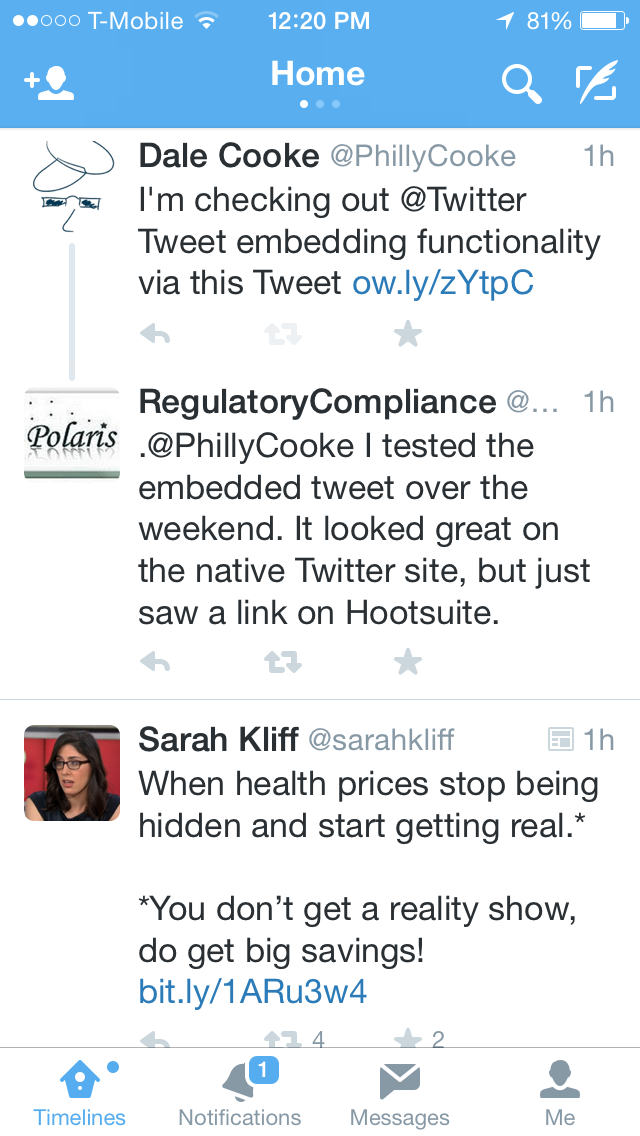
Of course, embedded Tweets don't show on Hootsuite, so I also checked on Twitter.com. Here's that view:
 |
| URL Shortener Usage on Twitter.com |
 |
| URL Shortener Usage on Mobile in Stream |
In both cases, only the shortened URL was displayed. That's a real shame as the savings of 46 characters (11 for shortened URL vs. 57 for the full URL) is huge in the realm of Tweets.
When I looked on mobile, I noticed another interesting feature. Namely, that while viewing your own Tweets from the Me portion of the app, the embedded Tweet doesn't appear, even when you provide the full URL. It actually looks the same as the Hootsuite view, presenting just the beginning of the full URL.
 |
| Multiple Embedded Tweets on Mobile Showing Shortener Usage |
h/t to Alec Gaffney & Polaris Consulting for this post.
Save Money While Learning about Google Text Ads
As I mentioned previously, I'll be speaking at CBI's one-day event on social media. CBI has confirmed that I can offer a $300 discount to anyone who contacts me via this blog.
Just fill out the contact form on the right, and I'll send you the promotional code by email.
Just fill out the contact form on the right, and I'll send you the promotional code by email.
EyeOnFDA Webinar Available Now
FDA Still Not Ready to Tackle Mobile Promotion
Updated to correct error of publishing an incomplete sentence and a misspelling.
On Thursday, FDA held a webinar about its recent social media guidances. Despite technical difficulties that prevented many (including me) from attending the webinar, FDA did field questions from some of the attendees, and late on Friday afternoon, they posted that Q&A along with the slides from the presentation portion of the event.
In reviewing the Q&A about the space-limited presentation of risk information guidance, one exchange stood out:
While the guidance itself clearly specifies that its scope is limited to social media platforms and paid search with character-count limitations*, it is disappointing to see the exchange. Perhaps it was the nature of the question that resulted in this specific answer, but one would certainly like to know how widely applicable the principles from this guidance are to mobile devices in particular because many of the issues that apply to presentation of risk information in limited character counts also apply to presentation in limited space.
In addition, though, this Q&A further emphasizes one of my concerns about the guidance. It concerns itself solely with the content of each individual Tweet** and completely ignores the surrounding context and nature of Twitter interactions. That larger context is part of what I have begun fleshing out via a previous post about a different Twitter proposal. There is far more going on when a person views a Tweet than just the 140 characters in the Tweet itself, and I believe that FDA is inappropriately limiting both its evaluation of what can make a Tweet compliant (or non-compliant) and its understanding of the actual uses of Twitter and other social media platforms.
Social media hosts public conversations, and just as you would not expect every single sentence uttered to include the complete conversation, you should not necessarily expect every Tweet to include everything needed to achieve a compliant communication.
Further adding to the difficulty is that just as FDA is finally providing guidance to address some of the most pressing issues in social media, we're seeing massive shifts in the consumption of social media itself with an increasing amount of social media interaction happening via mobile devices. So much so that some people have taken to referring to the combined fields as "somo" or "moso" to underline how much the line between social media and mobile has blurred.
* "This draft guidance also does not address responsive web design or other technology-specific layout features that may result in product promotion presentations that differ depending on the technology used to view them (e.g., desktop computer monitors, mobile devices, tablets)." (page 2)
** It's worth noting that people have been referring to this guidance informally as the Twitter guidance, and by refusing to discuss how to apply its principles beyond Twitter and Google, that moniker seems even more appropriate. For years, FDA declaimed its intention to not provide guidance that was limited to any specific platform(s) because of how rapidly the platforms evolved, and yet, ironically, it seems as if FDA is now intentionally doing exactly that.
On Thursday, FDA held a webinar about its recent social media guidances. Despite technical difficulties that prevented many (including me) from attending the webinar, FDA did field questions from some of the attendees, and late on Friday afternoon, they posted that Q&A along with the slides from the presentation portion of the event.
In reviewing the Q&A about the space-limited presentation of risk information guidance, one exchange stood out:
Q1. Does this draft guidance apply to space limitations imposed by mobile devices?A1: This draft guidance does not address technology-specific layout features that may result in product promotion presentations that differ depending on the technology used to view them (e.g., mobile devices, desktop computer monitors, and tablets). The scope of this draft guidance is specific to Internet/social media platforms that impose character space limitations.
While the guidance itself clearly specifies that its scope is limited to social media platforms and paid search with character-count limitations*, it is disappointing to see the exchange. Perhaps it was the nature of the question that resulted in this specific answer, but one would certainly like to know how widely applicable the principles from this guidance are to mobile devices in particular because many of the issues that apply to presentation of risk information in limited character counts also apply to presentation in limited space.
In addition, though, this Q&A further emphasizes one of my concerns about the guidance. It concerns itself solely with the content of each individual Tweet** and completely ignores the surrounding context and nature of Twitter interactions. That larger context is part of what I have begun fleshing out via a previous post about a different Twitter proposal. There is far more going on when a person views a Tweet than just the 140 characters in the Tweet itself, and I believe that FDA is inappropriately limiting both its evaluation of what can make a Tweet compliant (or non-compliant) and its understanding of the actual uses of Twitter and other social media platforms.
Social media hosts public conversations, and just as you would not expect every single sentence uttered to include the complete conversation, you should not necessarily expect every Tweet to include everything needed to achieve a compliant communication.
Further adding to the difficulty is that just as FDA is finally providing guidance to address some of the most pressing issues in social media, we're seeing massive shifts in the consumption of social media itself with an increasing amount of social media interaction happening via mobile devices. So much so that some people have taken to referring to the combined fields as "somo" or "moso" to underline how much the line between social media and mobile has blurred.
* "This draft guidance also does not address responsive web design or other technology-specific layout features that may result in product promotion presentations that differ depending on the technology used to view them (e.g., desktop computer monitors, mobile devices, tablets)." (page 2)
** It's worth noting that people have been referring to this guidance informally as the Twitter guidance, and by refusing to discuss how to apply its principles beyond Twitter and Google, that moniker seems even more appropriate. For years, FDA declaimed its intention to not provide guidance that was limited to any specific platform(s) because of how rapidly the platforms evolved, and yet, ironically, it seems as if FDA is now intentionally doing exactly that.
Still feeling the need to chat?
The highly anticipated FDA social media webinar happened today. Apparently, some people were able to attend; though based on my Twitter feed, it seemed as if more people were having problems than actually getting in.
I was one of those who experienced difficulties. I logged in at 1:45 for the 2 p.m. start because FDA had warned that it was already booked to max capacity. I received a message that the webinar hadn't begun and would start at 2 p.m.
2 p.m. came and no webinar, then 2:05. Then, I started scrambling trying to log in in a different browser, reloading the page, even restarted my computer.
Then (of course), I started checking Twitter and saw that other people were experiencing the same problems.
I received an email from FDA with a new link that also didn't work.
@US_FDA Tweeted out a message acknowledging the problems and promising to post slides later. BTW, they're here.
From what I can tell based on the commentary on Twitter, there was very little new ground covered. The consensus of the Twitter discussion was that FDA largely read directly from the guidances themselves (the slides seem to back up that view) and only chose questions to answer that were already answered in the guidance themselves.
As for the guidances themselves, I would suggest that there are still many unanswered questions, including this and this.
For an overview of the guidances, I'd recommend this one.
And given all of the technical difficulties and limited Q&A, I'm renewing my call for a Twitter chat about the guidances. If CDRH can do it, I'm not sure why the rest of the agency can't.
I was one of those who experienced difficulties. I logged in at 1:45 for the 2 p.m. start because FDA had warned that it was already booked to max capacity. I received a message that the webinar hadn't begun and would start at 2 p.m.
2 p.m. came and no webinar, then 2:05. Then, I started scrambling trying to log in in a different browser, reloading the page, even restarted my computer.
Then (of course), I started checking Twitter and saw that other people were experiencing the same problems.
I received an email from FDA with a new link that also didn't work.
@US_FDA Tweeted out a message acknowledging the problems and promising to post slides later. BTW, they're here.
From what I can tell based on the commentary on Twitter, there was very little new ground covered. The consensus of the Twitter discussion was that FDA largely read directly from the guidances themselves (the slides seem to back up that view) and only chose questions to answer that were already answered in the guidance themselves.
As for the guidances themselves, I would suggest that there are still many unanswered questions, including this and this.
For an overview of the guidances, I'd recommend this one.
And given all of the technical difficulties and limited Q&A, I'm renewing my call for a Twitter chat about the guidances. If CDRH can do it, I'm not sure why the rest of the agency can't.
FDA Social Media Guidance Webinar
I have been trying to get the FDA to host a Twitter chat, having suggested it on Twitter, and then followed up on this blog.
This morning @US_FDA announced that there will be a social media webinar later this week. There isn't much information about the webinar at the registration page, but the confirmation email includes the following description:
I hope you'll join the webinar as I'm sure we're all anxious to have this Q&A on the three social media guidances this year.
This morning @US_FDA announced that there will be a social media webinar later this week. There isn't much information about the webinar at the registration page, but the confirmation email includes the following description:
The purpose of this webinar is to provide an introduction and overview of FDA’s three recently issued social media draft guidances Fulfilling Regulatory Requirements for Postmarketing Submissions of Interactive Promotional Media for Prescription Human and Animal Drugs and Biologics, Internet/Social Media Platforms with Character Space Limitations— Presenting Risk and Benefit Information for Prescription Drugs and Medical Devices and Internet/Social Media Platforms: Correcting Independent Third-Party Misinformation About Prescription Drugs and Medical Devices. Subject-matter experts will also be available to answer questions regarding the draft guidances and provide further explanation of key concepts.
I hope you'll join the webinar as I'm sure we're all anxious to have this Q&A on the three social media guidances this year.
FDA Was Wrong About Google Functionality
I didn't say very much about the use of Google text ads in the Regulatory Alert that I released last week about the FDA space-limited risk & benefit presentation guidance. Partly, that's because I'm working on an article about Google text ads that updates the chapter in my primer.
There is, however, one extremely important item to point out. FDA got sitelinks wrong. I don't mean that I disagree about the FDA's view on the use of sitelinks. I mean they don't understand the technology, and what they say in the guidance demonstrates that.
The FDA guidance recommends using sitelinks to include some risk information that the FDA says people must include if they are presenting product benefit information (and the product name). The example they give is:

In this example, the benefit information "For severe headache from traumatic brain injury" requires corresponding risk information to be balanced.
The FDA accomplishes that risk presentation via the various sitelink descriptions "Potential for brain swelling," "Life-threatening drop in heart rate," etc. Importantly, the words in the sitelinks themselves "Boxed warning," "Warning," and "Risk information" do not themselves constitute risk information, just links to risk information. Consequently, those links in themselves do not suffice to provide the risk information.
The first problem with this is that FDA is assuming that a product manufacturer can guarantee that their ads have the sitelinks and the link descriptions appear when they run the ad. But you don't have that control.
Google does not guarantee that sitelinks will ever appear. In fact, Google's page dedicated to sitelinks in paid search campaigns, includes a section header called, "Why your sitelinks aren't showing," and the first sentence under that header reads, "Keep in mind that your ads won't always show sitelinks."
That's a problem because if your ad is running with benefit information presented in the body of the ad, the ad requires the risk information to meet the fair balance requirement. If your ad displaying the benefit information does not include the sitelinks, then the ad would violate the fair balance requirement.
So, if the maker of HeadHurtz were to actually run the ad that the FDA provides as an example, there's a significant chance that the ad would actually appear as follows:

This ad would definitely be violative because as we learned in 2009, and as FDA reiterates in this guidance, if the product name and benefit information is presented, then FDA requires that some risk information be presented at the same time with comparable prominence as the benefit information.
So following the FDA's provided example could result in violative promotional activity. Moreover, even if the sitelinks appear, there's a chance that the sitelink description would not appear. But again, the sitelinks provided in the example ("Warning," etc.) do not in themselves provide risk information. So, just providing the sitelinks would not meet the fair balance requirement.
Further compounding the problems with the FDA's example is that the order and number of sitelinks provided varies without complete control by the advertiser. So, if all four sitelinks were not provided, there's a chance (based on FDA's guidance) that the advertiser might not be complying the fair balance requirement because FDA might deem it necessary to provide ALL four sitelinks to meet that requirement.
As if these problems were not enough, there's one more difficulty: mobile devices. If this ad were enabled for display on mobile phones (which is not required for Google ads but is encouraged), then you would definitely not have all four sitelinks presented, and none of the descriptions of the sitelinks would be presented.
So, the sample ad presented by the FDA could definitely not run on mobile phones, but of course, mobile access to the Internet is exploding, and in fact, some people (hint: me) believe that providing information via mobile devices is even more important than doing so via desktop.
There is, however, one extremely important item to point out. FDA got sitelinks wrong. I don't mean that I disagree about the FDA's view on the use of sitelinks. I mean they don't understand the technology, and what they say in the guidance demonstrates that.
The FDA guidance recommends using sitelinks to include some risk information that the FDA says people must include if they are presenting product benefit information (and the product name). The example they give is:
In this example, the benefit information "For severe headache from traumatic brain injury" requires corresponding risk information to be balanced.
The FDA accomplishes that risk presentation via the various sitelink descriptions "Potential for brain swelling," "Life-threatening drop in heart rate," etc. Importantly, the words in the sitelinks themselves "Boxed warning," "Warning," and "Risk information" do not themselves constitute risk information, just links to risk information. Consequently, those links in themselves do not suffice to provide the risk information.
The first problem with this is that FDA is assuming that a product manufacturer can guarantee that their ads have the sitelinks and the link descriptions appear when they run the ad. But you don't have that control.
Google does not guarantee that sitelinks will ever appear. In fact, Google's page dedicated to sitelinks in paid search campaigns, includes a section header called, "Why your sitelinks aren't showing," and the first sentence under that header reads, "Keep in mind that your ads won't always show sitelinks."
That's a problem because if your ad is running with benefit information presented in the body of the ad, the ad requires the risk information to meet the fair balance requirement. If your ad displaying the benefit information does not include the sitelinks, then the ad would violate the fair balance requirement.
So, if the maker of HeadHurtz were to actually run the ad that the FDA provides as an example, there's a significant chance that the ad would actually appear as follows:
This ad would definitely be violative because as we learned in 2009, and as FDA reiterates in this guidance, if the product name and benefit information is presented, then FDA requires that some risk information be presented at the same time with comparable prominence as the benefit information.
So following the FDA's provided example could result in violative promotional activity. Moreover, even if the sitelinks appear, there's a chance that the sitelink description would not appear. But again, the sitelinks provided in the example ("Warning," etc.) do not in themselves provide risk information. So, just providing the sitelinks would not meet the fair balance requirement.
Further compounding the problems with the FDA's example is that the order and number of sitelinks provided varies without complete control by the advertiser. So, if all four sitelinks were not provided, there's a chance (based on FDA's guidance) that the advertiser might not be complying the fair balance requirement because FDA might deem it necessary to provide ALL four sitelinks to meet that requirement.
As if these problems were not enough, there's one more difficulty: mobile devices. If this ad were enabled for display on mobile phones (which is not required for Google ads but is encouraged), then you would definitely not have all four sitelinks presented, and none of the descriptions of the sitelinks would be presented.
So, the sample ad presented by the FDA could definitely not run on mobile phones, but of course, mobile access to the Internet is exploding, and in fact, some people (hint: me) believe that providing information via mobile devices is even more important than doing so via desktop.
Subscribe to:
Posts (Atom)